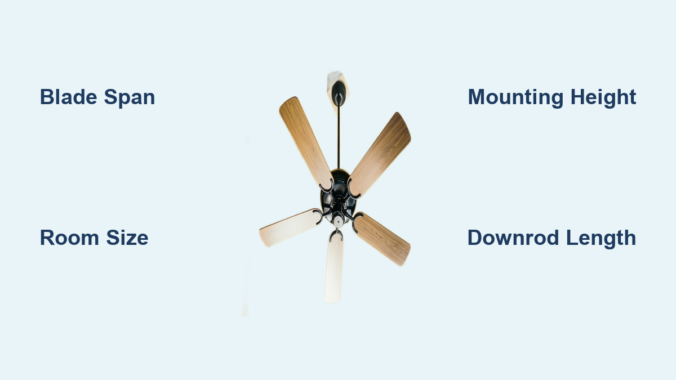
Choosing the right ceiling fan starts with understanding standard ceiling fan dimensions and how they match your room size. The blade span—the total diameter when blades fully extend—is the critical measurement that determines whether your fan will effectively circulate air or leave you with uncomfortable hot and cold spots. A fan that’s too small won’t move enough air to create comfortable conditions, while an oversized fan can overwhelm your space visually and create uncomfortable wind tunnel effects. This guide breaks down every dimension you need to consider, from blade span to mounting heights and clearance requirements, so you can select a fan that performs optimally and looks proportionate in your space.
Why Your Room’s Square Footage Determines Fan Size
Matching blade span to room square footage represents the foundation of proper ceiling fan selection. Industry standards divide rooms into four primary categories based on size, each with recommended fan dimensions that ensure adequate airflow without overwhelming your space. These guidelines reflect consensus recommendations from major manufacturers and help homeowners avoid the two most common mistakes: selecting a fan too small to effectively circulate air or choosing one so large it creates excessive airflow and visual imbalance.
For rooms up to 75 square feet such as small bathrooms, hallways, and compact bedrooms, fans with 29 to 36 inch blade spans provide adequate air circulation without creating uncomfortable drafts. Spaces between 75 and 175 square feet—the most common residential applications—work best with 36 to 48 inch fans. Rooms ranging from 175 to 350 square feet need 48 to 56 inch blades, while areas exceeding 350 square feet demand fans of 60 inches or larger. When your room dimensions fall near category boundaries, rounding up typically provides better airflow than sizing down since you can always run a larger fan at lower speeds.
Small Room Fan Dimensions: Perfect Sizes for Bathrooms & Hallways
Compact spaces including small bathrooms, hallways, porches, mud rooms, and tiny bedrooms require small ceiling fans designed for rooms up to 75 square feet. These 29 to 36 inch fans provide adequate air circulation without creating the wind tunnel effect that larger fans produce in confined spaces. For rooms of 50 square feet or smaller, fans under 29 inches with CFM ratings under 1,000 work effectively while maintaining proper proportionality.
Key considerations for small room fans:
– CFM range typically falls between 1,000 and 2,000 cubic feet per minute
– Ideal for bathrooms where exhaust fans handle moisture removal
– Perfect for narrow hallways where larger fans would appear disproportionate
– Smaller fans maintain visual harmony in compact spaces
Medium Room Fan Dimensions: Ideal for Bedrooms & Living Areas
Medium-sized rooms represent the most common ceiling fan applications, encompassing large bathrooms, typical bedrooms, home offices, living rooms, and kitchens ranging from 75 to 175 square feet. Fans in the 36 to 48 inch blade span category accommodate these spaces effectively, with CFM ratings up to 3,800 providing robust air circulation for comfortable living.
For rooms up to 144 square feet specifically, a blade span of 36 to 44 inches delivers optimal airflow without dominating the room visually. Rooms approaching the upper limit of this category—around 150 to 175 square feet—benefit from fans at the larger end of the spectrum, closer to 48 inches. The 42-inch category is particularly popular for smaller bedrooms and offices, while 44 to 48 inch fans suit larger living areas. This versatility makes the medium size range the most popular choice for residential applications, balancing airflow capacity with aesthetic proportionality in typical room dimensions.
Large Room Fan Dimensions: Solutions for Great Rooms & High Ceilings

Expansive living rooms, great rooms, dining areas, and spaces with cathedral or vaulted ceilings ranging from 175 to 350 square feet require larger ceiling fans to effectively circulate air throughout the considerable volume of space. The recommended blade span for these rooms ranges from 48 to 56 inches, with CFM ratings approaching 8,000 for optimal performance in these demanding applications.
These larger rooms present unique airflow challenges because the increased vertical space—whether from standard 9-foot ceilings or soaring cathedral configurations—requires more air movement to achieve comfortable conditions at living level. The wider blade span allows the fan to move a greater volume of air with each rotation, compensating for the larger space that air must traverse. Rooms with high ceilings in this size range particularly benefit from the additional airflow capacity, as the greater vertical space naturally reduces air circulation at occupant level without mechanical assistance.
Extra Large Room Fan Dimensions: When One Fan Isn’t Enough

Spaces exceeding 350 square feet—including gymnasiums, exercise studios, large public areas, covered outdoor spaces, and very expansive living areas—require ceiling fans with blade spans of 60 inches or larger. These fans typically feature CFM ratings ranging from 8,000 to 16,900 or higher, providing substantial air movement necessary for extensive spaces where smaller fans would prove entirely inadequate.
For optimal coverage in extra-large rooms:
– Multiple smaller fans often provide superior air circulation compared to one oversized unit
– Strategic placement creates overlapping airflow patterns that condition the entire space
– Open-concept areas over 400 square feet particularly benefit from multi-fan setups
– Two properly sized fans typically outperform one oversized fan in creating comfortable conditions
Minimum Height Clearances: Avoiding Safety Hazards
Safety and optimal performance require ceiling fan blades to maintain specific distances from ceilings, walls, and the floor. Blades must sit at least 7 feet above the floor at all times to prevent contact injuries during normal room use—this minimum clearance is a hard safety requirement. For ceiling fans with metal blades specifically, the minimum clearance increases to 10 feet above the floor, since metal blades can cause more significant injury upon contact compared to plastic or wooden alternatives.
The ideal fan height from floor to blades measures approximately 8 feet, positioning the fan at a comfortable level for most adults while maintaining optimal airflow patterns. Standard-mount ceiling fans require approximately 12 to 14 inches of space from blade tips to the ceiling, allowing adequate clearance for airflow around the fan assembly. Flush-mount or hugger fans, designed for installation directly against the ceiling surface, require only 6 to 10 inches of clearance from blade to ceiling, making them suitable for rooms with lower ceilings.
Downrod Length Calculator: Matching to Your Ceiling Height
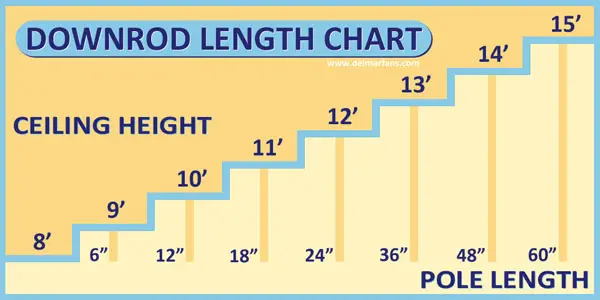
Selecting the correct downrod length ensures your fan blades end up at the ideal 8-foot height regardless of your ceiling configuration. For ceilings measuring 8 to 9 feet, standard mounting with the included downrod typically suffices. Nine-foot ceilings call for a 12-inch downrod to bring the fan to optimal height. Ten-foot ceilings require an 18-inch downrod, while 11-foot ceilings call for a 24-inch downrod. Twelve-foot ceilings need a 36-inch downrod, thirteen-foot ceilings require 48 inches, fourteen-foot ceilings demand 60 inches, and ceilings exceeding 15 feet may require downrods up to 72 inches long.
Low ceilings ranging from 7.5 to 9 feet call for hugger or flushmount fans that mount directly against the ceiling without a downrod. Standard ceilings between 8 and 9 feet accommodate most ceiling fans with their included standard downrods. High ceilings exceeding 9 feet require extended downrod mounting to lower the fan to the proper height. Sloped or vaulted ceilings also require downrod installation to ensure the fan hangs level and at the correct height for safe operation.
How to Measure Blade Span Accurately (Even With Odd Blades)
Understanding how ceiling fan size is measured prevents confusion when comparing specifications. For fans with an even number of blades, measure from the tip of one blade to the tip of the directly opposite blade. For fans with an odd number of blades (like three or five), measure from the center of the fan motor to the tip of any blade, then multiply that measurement by two to obtain the total blade span.
To determine the appropriate ceiling fan size for your specific room, first calculate the room’s square footage by multiplying length by width in feet. For rectangular rooms, this straightforward calculation applies directly. Irregularly shaped rooms may require dividing the space into smaller rectangles, calculating square footage for each section. Always round up when selecting fan size if room dimensions fall near boundary lines between size categories—slightly oversizing provides better airflow than undersizing.
Outdoor Ceiling Fan Dimensions: Special Considerations
Outdoor ceiling fan dimensions follow similar principles to indoor applications but require additional considerations. Small porches under 145 square feet may require smaller fans than comparable indoor spaces, while larger outdoor areas benefit from fans sized according to standard guidelines. Because outdoor spaces typically feature more open air circulation, homeowners often opt for outdoor fans that are slightly larger than they would choose for a comparable indoor space.
Outdoor fan safety requirements:
– Damp-listed fans for covered outdoor areas completely protected from water
– Wet-listed fans required for areas directly exposed to water
– Never install an indoor-rated fan in an outdoor location
– Outdoor fans must withstand moisture, humidity, and temperature fluctuations
Blade Design Impact on Airflow Efficiency
Beyond blade span, the design and configuration of fan blades significantly impact airflow efficiency. The angle or pitch of ceiling fan blades critically affects airflow efficiency, with optimal blade pitch typically ranging from 12 to 15 degrees. Steeper blades encounter more air resistance, which translates to greater air movement but may require more powerful motors.
The number of blades affects both performance characteristics and visual appearance. Traditional ceiling fans typically feature four or five blades, balancing airflow efficiency with quiet operation. Fans with three blades tend to be more efficient at moving air due to reduced drag, while fans with more blades operate more quietly but may slightly compromise airflow capacity. The choice ultimately depends on balancing performance priorities, noise tolerance, and aesthetic preferences.
Choosing the Right Fan Size: Proportionality Rules
Aesthetic proportionality recommends that ceiling fan width represent between 20% and 25% of the room’s width measurement. For example, a room measuring 16 feet wide would optimally accommodate a fan with a blade span between 3.2 and 4 feet (38 to 48 inches). While functional performance should remain the primary consideration, these proportional guidelines help achieve a balanced visual appearance.
The 52-inch ceiling fan has emerged as the industry standard for average-sized residential rooms, working effectively in spaces from approximately 12 by 12 feet to 18 by 18 feet. This size covers the majority of bedrooms, living rooms, and common areas in typical homes. Slightly larger fans generally perform adequately even in smaller rooms when operated at lower speeds, while slightly smaller fans can compensate through strategic placement or adding a second fan in larger rooms.
Leave a Reply