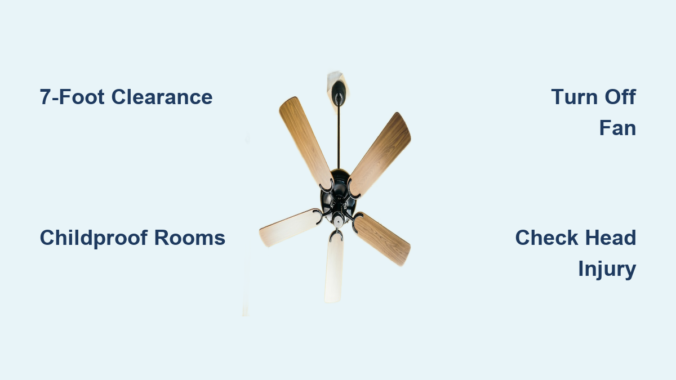
Every year, thousands of people suffer head injuries from ceiling fans—yet most homeowners never consider this overhead hazard until it’s too late. A standard ceiling fan rotating at 200-250 revolutions per minute creates blade tips moving at 15-20 miles per hour, generating enough force to cause anything from minor bumps to severe traumatic brain injuries. These accidents happen silently in the most familiar spaces of your home, often during routine activities like getting out of bed or playing with children. Understanding how ceiling fan head injuries occur, who’s most at risk, and what specific prevention steps actually work could save you from a painful—and completely preventable—accident that many families experience without realizing the danger exists.
This guide reveals the hidden risks of ceiling fans and provides actionable strategies to protect your family. Whether you’re a parent evaluating your child’s bedroom, a new homeowner inspecting installations, or someone who’s already experienced a ceiling fan head injury, you’ll learn the critical safety measures that medical professionals and safety experts recommend. We’ll cover the specific injury patterns to watch for, the exact installation standards that keep families safe, warning signs requiring immediate medical attention, and practical modifications that transform hazardous setups into secure home environments.
Why Ceiling Fan Blades Cause More Damage Than You’d Expect
Ceiling fan head injuries involve a dangerous combination of blade speed, weight, and rotational mechanics that most people underestimate. Unlike hitting a stationary object, a rotating ceiling fan blade strikes multiple times in rapid succession as it completes its arc—creating a distinctive pattern of parallel injuries across the scalp or face that emergency doctors can actually use to identify the cause. A wooden blade delivers a solid impact that can fracture nasal bones with surprising force, while plastic blades may shatter on contact, embedding fragments in wounds and creating more complex injuries. The most dangerous scenario occurs when metal blades fail at their attachment points, turning the entire blade into a projectile capable of causing catastrophic injury.
Your ceiling fan’s tip speed matters more than you think—a 52-inch fan rotating at 250 RPM generates blade tip speeds of approximately 18 miles per hour. This may not sound fast until you consider that a direct hit to the temple or forehead at this velocity can cause concussions or skull fractures, especially in children whose skulls haven’t fully hardened. The temporal and frontal regions of the skull offer less natural protection than the thicker parietal bones, making these areas particularly vulnerable to serious injury from what might seem like a minor bump. Many victims initially dismiss their symptoms because external wounds look minor, only to develop severe headaches, confusion, or vision problems hours later when the brain injury becomes apparent.
Children Under 14 Face Highest Risk of Serious Ceiling Fan Head Injury
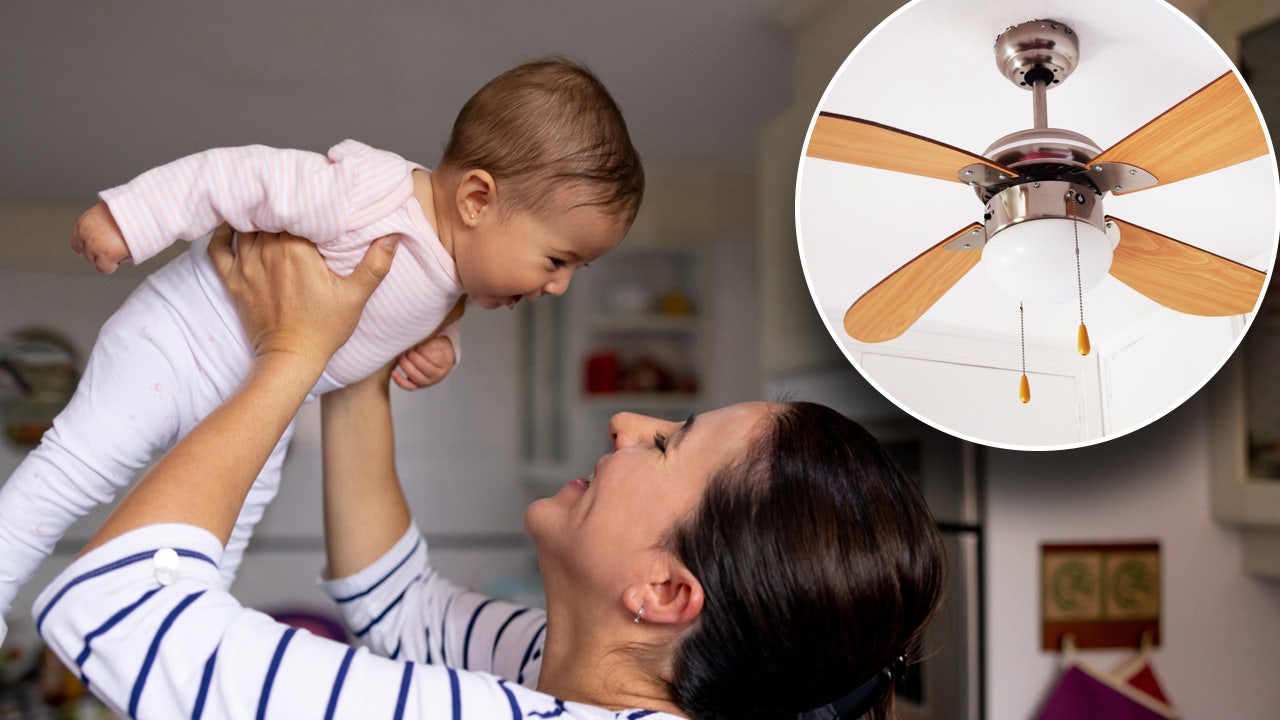
Statistical analysis shows children aged 5-14 years experience ceiling fan head injuries at rates far exceeding other age groups, with bed jumping being the #1 cause of injury in this demographic. Their height places their heads directly in the path of standard ceiling fan blades during normal play activities, and their developing spatial awareness means they often don’t recognize the danger until they’re already within the striking zone. Younger children (2-5 years) frequently sustain injuries from climbing on furniture beneath fans, with facial impacts being most common due to their proportionally larger head size.
Adults aged 25-40 represent the second highest-risk group, though their injuries typically occur under different circumstances. Alcohol consumption plays a significant role in adult ceiling fan head injuries, with impaired coordination leading to accidental contact during activities like reaching for items stored above fan level or participating in playful behavior that brings their heads into the blade path. Warning: Even a single beer can significantly reduce your spatial awareness, making you more likely to misjudge clearance distances when moving near operating fans.
Geographic and housing factors dramatically increase your risk. Homes in warmer climates with year-round fan usage see substantially higher incident rates, while apartments, older homes, and manufactured housing with lower ceiling heights create persistent collision hazards. If your ceiling measures less than 8 feet from floor to ceiling, your fans likely operate dangerously close to head height during normal activities—especially when sitting or standing on furniture.
Minimum 7-Foot Clearance: The Critical Safety Standard You Must Measure
Inadequate installation height represents the single most significant modifiable risk factor for ceiling fan head injuries, yet countless homes feature fans mounted at heights that create unnecessary danger. Building codes and manufacturer recommendations universally specify a minimum of 7 feet from the floor to the lowest point of the fan assembly—measured when the fan is operating at its highest speed. However, 8-9 feet is strongly preferred for optimal safety, creating additional margin that accounts for reaching activities, furniture placement variations, and momentary lapses in spatial awareness that affect everyone.
To check your clearance, turn on the fan at high speed and measure from the floor to the lowest point of any rotating component—not just the motor housing. If your measurement falls below 7 feet, you have three practical options:
– Install a longer downrod to raise the fan (requires electrical assessment)
– Replace with a low-profile “hugger” fan designed for higher mounting
– Convert the fixture to a non-rotating light that eliminates blade hazards
Pro Tip: When installing new fans, always choose a downrod length that positions the fan at least 8 feet above the floor—even if it means custom ordering a longer rod. The modest additional cost provides critical safety margin that pays dividends for the life of the installation.
Immediate Medical Red Flags After a Fan Head Impact
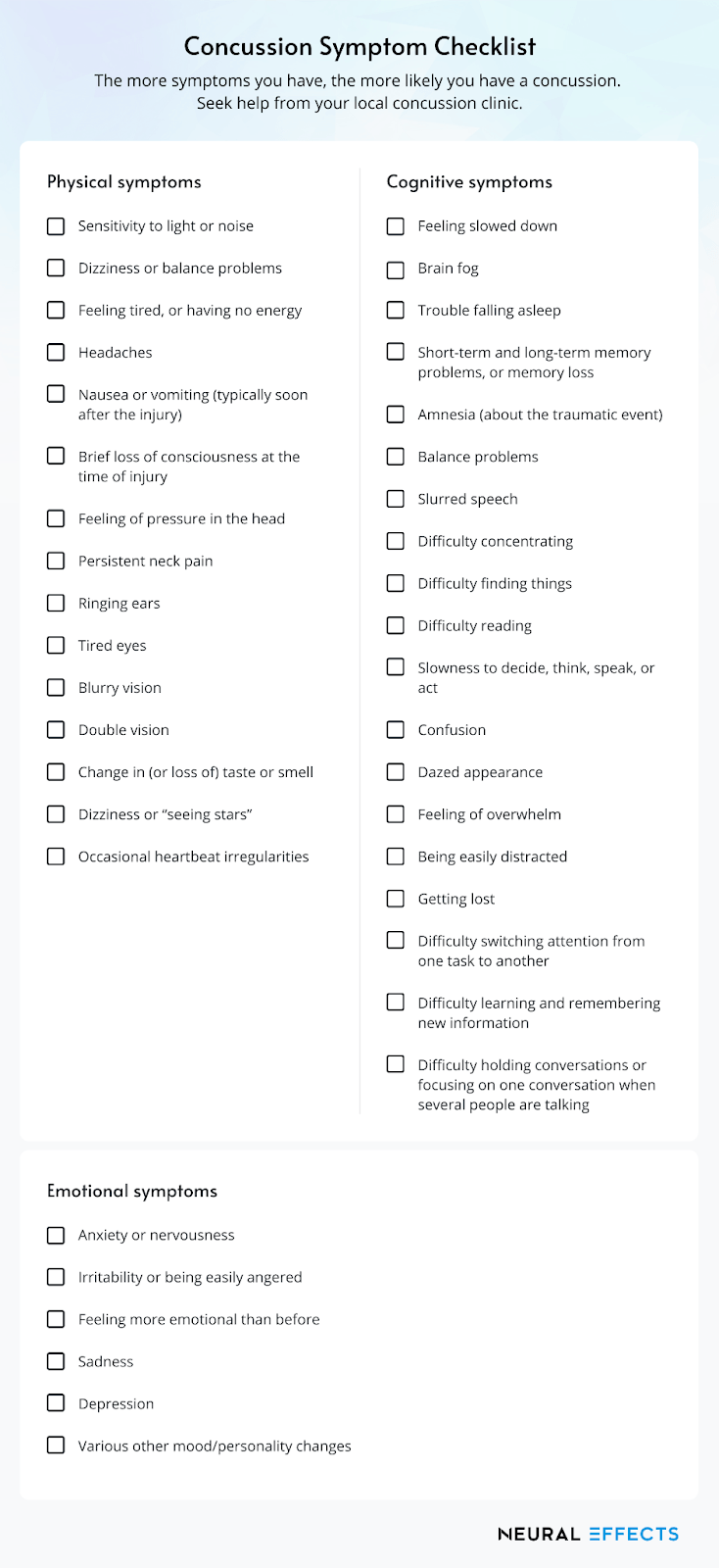
Not all ceiling fan head injuries require emergency treatment, but certain symptoms demand immediate professional evaluation. Any loss of consciousness—even briefly—following a ceiling fan impact requires emergency assessment, as this indicates potential traumatic brain injury. Many victims mistakenly believe they must have been “knocked out” for an extended period to have suffered brain injury, but even momentary disorientation or “blacking out” signals impact severe enough to disrupt normal brain function.
Watch for these neurological symptoms that may develop hours after the initial injury:
– Headache that worsens over time rather than gradually improving
– Persistent confusion or disorientation
– Repeated vomiting
– Slurred speech
– Weakness or numbness in extremities
– Difficulty walking
Facial injuries involving obvious deformity, significant swelling, uncontrolled bleeding, or impaired function (such as inability to see properly or breathe through the nose) also require emergency evaluation. The safest approach after any significant ceiling fan head injury is to seek medical evaluation rather than attempting to self-diagnose the severity of potentially invisible internal damage.
Five Steps to Childproof Your Ceiling Fans Today
Families with young children should implement these specific safety measures immediately to prevent ceiling fan head injuries:
-
Conduct a child’s-eye-view assessment—kneel or crawl at your child’s height and look up at each fan. What appears safe from adult height may create obvious collision hazards from a child’s perspective.
-
Relocate beds and play areas—move all beds, cribs, and children’s seating areas at least 3 feet away from directly beneath ceiling fans. If room layout prevents this, consider fan removal or modification.
-
Implement a strict no-bed-jumping rule—this simple household rule prevents not only ceiling fan injuries but also other bed-related accidents. Enforce it consistently with visual reminders like ceiling fan warning decals.
-
Limit fan operation in children’s rooms—use smart controls to run fans only during supervised hours, or program them to shut off automatically when motion sensors detect someone entering the blade path.
-
Educate progressively as children mature—young children need simple rules (“Never jump on beds near fans”), while older children can understand the biomechanics of blade impacts and participate in identifying safe behaviors.
What to Do in the Critical First Minutes After an Injury
When a ceiling fan head injury occurs, your immediate response significantly affects outcomes. First, turn off the fan immediately to prevent additional impacts, then assess the injured person’s consciousness level and ability to respond to simple questions. If they lost consciousness, appear confused, or show signs of disorientation, call emergency services immediately—don’t attempt to drive them to the hospital yourself, as paramedics can begin assessment during transport.
For injuries that don’t appear immediately severe:
– Apply cold compresses to reduce swelling (avoid direct pressure on deformities)
– Monitor closely for 24-48 hours for delayed symptoms like worsening headache
– Document the incident with photos of injury patterns and room configuration
– Seek medical evaluation even if symptoms seem minor initially
Never dismiss a head injury as “just a bump”—concussion symptoms often develop gradually over hours, and having another person monitor the injured individual allows for faster response if symptoms worsen.
Key Takeaways: Making Your Home Ceiling Fan Safe
Preventing ceiling fan head injuries requires measuring your existing installations, adjusting furniture arrangements, establishing clear household rules, and correcting any installations below the 7-foot clearance standard. For families with young children, these precautions should be implemented comprehensively and reinforced consistently until children develop judgment that keeps them safe even without supervision. The investment of time and modest expense to correct hazardous configurations pays dividends by preventing injuries that can cause pain, medical expenses, and in severe cases, permanent disability.
If a ceiling fan head injury does occur, seeking appropriate medical evaluation—even when injuries appear minor—protects against delayed onset of serious symptoms that characterize many traumatic brain injuries. Documenting incidents thoroughly preserves valuable information for medical assessment and any potential claims. By combining prevention knowledge with appropriate response protocols, you position yourself to protect your family from this overlooked household hazard while responding effectively if an incident does occur despite your best efforts.
Leave a Reply