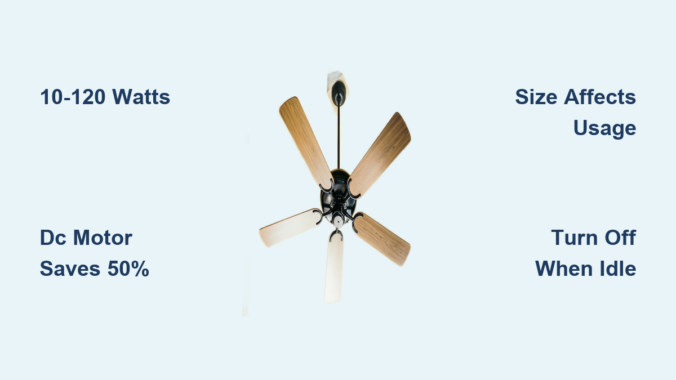
Wondering how many watts a ceiling fan uses? Most residential ceiling fans consume between 10 and 120 watts per hour during operation, with the exact figure depending on fan size, motor type, and speed settings. A standard 48-inch ceiling fan with an AC motor typically operates around 75 watts, providing an effective benchmark for energy calculations. Understanding your ceiling fan’s wattage helps you estimate electricity costs accurately and make smarter purchasing decisions that save money long-term. This guide breaks down exactly how many watts your ceiling fan uses across different sizes, motor types, and usage scenarios—plus practical strategies to minimize energy consumption without sacrificing comfort.
Typical Wattage by Fan Size
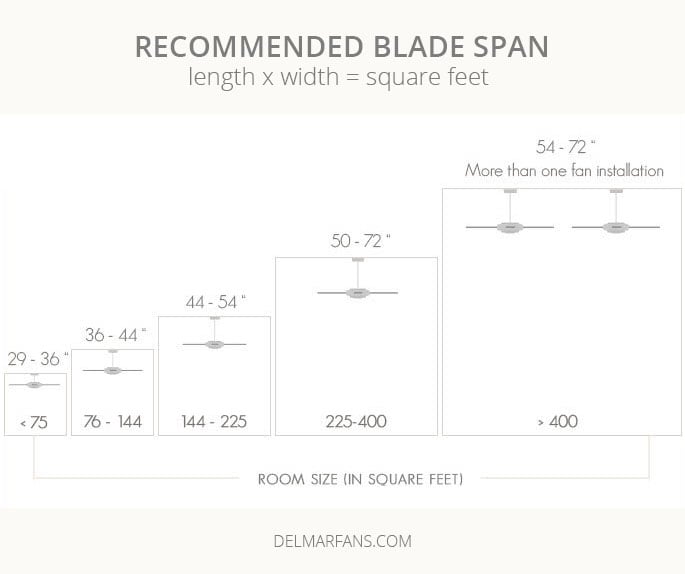
The wattage your ceiling fan uses directly corresponds to its blade span since larger fans need more powerful motors to move air across greater surface areas. Selecting the right size fan for your space prevents unnecessary energy expenditure while ensuring adequate airflow.
| Fan Size (Blade Span) | Watts Consumed |
|---|---|
| 24 inch | 41 watts |
| 30 inch | 48 watts |
| 36 inch | 55 watts |
| 42 inch | 65 watts |
| 48 inch | 75 watts |
| 52 inch | 87 watts |
| 56 inch | 100 watts |
| 60 inch | 120 watts |
| 72 inch | 180 watts |
For most homes, fans between 36 and 52 inches deliver optimal balance between cooling performance and energy efficiency. A 36-inch model uses approximately 55 watts, while a 52-inch unit requires about 87 watts—representing a manageable increase for significantly better air circulation. Oversized fans for small rooms waste energy, so always match fan size to room dimensions: 36-42 inches for bedrooms, 44-54 inches for living rooms, and 50-60 inches for larger open spaces.
How Size Affects Your Electricity Bill
Running a fan that’s too large for your space can increase how many watts your ceiling fan uses by 25-50% unnecessarily. A properly sized fan maintains comfort while minimizing energy consumption—critical information when calculating monthly costs. For example, a 48-inch fan running 8 hours daily adds just $1.80 to your bill at average electricity rates, while an oversized 60-inch model could cost $2.70 for the same usage pattern. Always verify your room dimensions against manufacturer size recommendations before purchasing.
DC vs AC Motor Efficiency

The motor type dramatically impacts how many watts your ceiling fan uses during operation, with DC (Direct Current) motors offering revolutionary efficiency improvements over traditional AC (Alternating Current) designs.
Why DC Motors Save Significant Energy
DC motor ceiling fans consume only 5 to 50 watts—50-70% less than AC models—while delivering equal or superior airflow. This efficiency comes from more precise electronic control and better energy conversion. While standard AC fans typically use 50-120 watts on high settings, DC models maintain comfortable air movement at dramatically lower power levels. The difference becomes especially pronounced when running fans for extended periods.
Practical Benefits Beyond Energy Savings
DC motor fans provide six or more speed settings compared to the three-speed limitation of most AC models, allowing you to fine-tune power consumption based on actual comfort needs. These fans also operate more quietly and include remote control functionality as standard. While the initial purchase price is higher, the energy savings often offset this cost within 1-2 years of regular use—particularly valuable when calculating how many watts your ceiling fan uses over its lifetime.
Compare Ceiling Fan Wattage to Other Fan Types

Understanding how many watts your ceiling fan uses becomes more meaningful when comparing it to alternative cooling options in your home.
| Fan Type | Average Watts Used | Daily Energy (8 hours) |
|---|---|---|
| Ceiling Fan | 30W – 120W | 0.24 – 0.96 kWh |
| Tower Fan | 30W – 100W | 0.24 – 0.80 kWh |
| Pedestal Fan | 40W – 75W | 0.32 – 0.60 kWh |
| Table Fan | 20W – 50W | 0.16 – 0.40 kWh |
| Bladeless Fan | 20W – 70W | 0.16 – 0.56 kWh |
| Industrial Fan | 150W – 1500W | 1.2 – 12 kWh |
Ceiling fans provide the best coverage-to-efficiency ratio, circulating air throughout entire rooms more effectively than portable options. While table fans consume slightly less power (20-50 watts), they only cool localized areas. Industrial fans represent extreme consumption levels, with some units drawing over 1500 watts—comparable to air conditioning units.
Calculate Daily and Monthly Energy Costs
Determining how many watts your ceiling fan uses enables precise cost calculations using this simple formula:
Daily Cost = (Wattage ÷ 1000) × Hours Used × Electricity Rate
A 48-inch ceiling fan operating at 50 watts for 8 hours daily with electricity at $0.15/kWh costs just $0.06 per day or $1.80 monthly. At maximum 75 watts, costs increase to $0.09 daily or $2.70 monthly. For continuous 24-hour operation, these figures triple.
| Fan Size | Monthly kWh Use (8 hrs/day) |
|---|---|
| 36 inches | 7.2 – 12 kWh |
| 48 inches | 12 – 18 kWh |
| 60 inches | 18 – 28.8 kWh |
Real-World Cost Examples
- 36-inch fan running 8 hours daily: $0.90-$1.50 monthly
- 48-inch fan running 12 hours daily: $2.70-$4.05 monthly
- 60-inch fan running 24/7: $9.07-$14.51 monthly
These calculations help you budget accurately and identify whether your current usage aligns with energy-saving goals.
Reduce Your Ceiling Fan Energy Costs
How many watts your ceiling fan uses isn’t fixed—you can implement several strategies to minimize consumption while maintaining comfort.
Smart Purchasing Decisions
- Select ENERGY STAR certified models that consume approximately 60% less power through improved motors and blade designs
- Choose DC motor fans for the most significant efficiency gains
- Verify wattage specifications before purchasing—don’t assume all fans in the same size category consume equal power
Usage Optimization Tactics
- Adjust speed settings based on actual needs: Running on low (15-30 watts) instead of high (50-75 watts) can cut energy use by 50-70%
- Turn fans off when rooms are unoccupied: Fans cool people, not spaces—leaving them running wastes electricity
- Pair with air conditioning: Raise thermostat settings 4-5 degrees while maintaining comfort, reducing AC costs by 25-30%
Implementing these practices can reduce cooling-related electricity expenses by up to 30%, making your ceiling fan an even more cost-effective solution.
Solar Power Options for Off-Grid Cooling
For homeowners seeking alternative energy solutions, solar generators provide viable options for powering ceiling fans independently of grid electricity.
Sizing Your Solar Generator
Calculate required capacity using this formula:
Watt-hours needed = Fan Wattage × Hours of Operation × 1.15 (efficiency factor)
A 75-watt ceiling fan running 8 hours requires approximately 690 watt-hours of solar generator capacity. The following table shows runtime for different fan sizes with a 1264Wh capacity unit:
| Fan Size | Runtime on 1264Wh Generator |
|---|---|
| 24-inch (41W) | ~26 hours |
| 48-inch (75W) | ~14.3 hours |
| 60-inch (120W) | ~9 hours |
| 72-inch (180W) | ~6 hours |
Smaller 518Wh units provide proportionally reduced runtime, powering a 48-inch fan for approximately 5.9 hours. These calculations include real-world efficiency considerations to ensure reliable off-grid cooling.
Key Facts About Ceiling Fan Wattage
Understanding how many watts a ceiling fan uses comes down to several essential facts that guide smart purchasing and usage decisions:
- Standard residential fans consume 10-120 watts, with most models falling in the 30-75 watt range
- DC motor fans use 50-70% less power than AC equivalents while offering quieter operation and more speed options
- Typical residential fans add $1-$15 monthly to electricity bills depending on size and usage patterns
- Pairing fans with air conditioning can reduce total cooling costs by up to 30% through strategic thermostat adjustments
- Turning fans off in unoccupied rooms eliminates 100% of that fan’s energy consumption with no comfort penalty
By selecting appropriately sized fans, choosing efficient DC motor models, and implementing smart usage habits, you can maximize comfort while minimizing how many watts your ceiling fan uses—keeping your home cool without cooling your wallet.
Leave a Reply