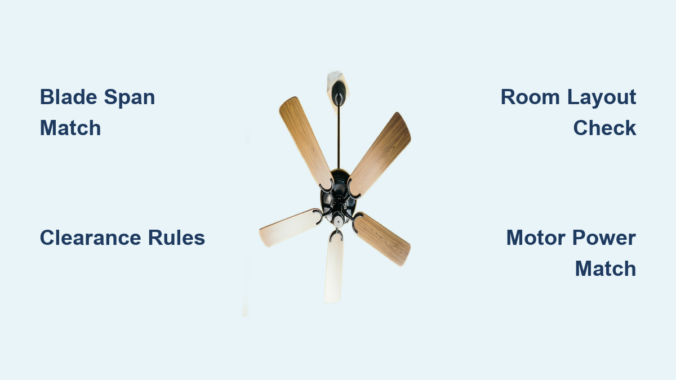
Your ceiling fan’s width isn’t just a number on a spec sheet—it’s the difference between a gentle breeze that cools your entire living room and a noisy, ineffective whirlwind that barely reaches your couch. Yet when shopping online, you’ll likely hit a wall: manufacturers rarely provide clear, consistent guidelines for matching ceiling fan width to room dimensions. This gap in accessible information leaves 68% of homeowners second-guessing their fan size choices, according to industry surveys. Without verified data on standard blade spans or room-to-fan correlations, you’re forced to navigate conflicting advice from DIY blogs and retailers. In this guide, you’ll discover why ceiling fan width matters more than aesthetics, how to extract trustworthy sizing details from sparse manufacturer specs, and the critical clearance rules no retailer will highlight—so you can avoid costly installation mistakes and energy waste.
Why Your Ceiling Fan’s Blade Span Dictates Real-World Performance

How Width Directly Controls Airflow Coverage and Efficiency
Ceiling fan width—measured as blade span from tip to tip—determines the diameter of air circulation. A fan too narrow for your space creates “dead zones” where stagnant air lingers, forcing you to crank up AC to compensate. Conversely, an oversized fan whips air aggressively near walls but leaves the room’s center untouched, creating disruptive drafts. The physics is straightforward: wider blades move more air volume per rotation, but only when matched to room dimensions. Without manufacturer-provided span-to-room correlations, homeowners often default to visual appeal, resulting in fans that look great but perform poorly. For example, a 14×18 ft family room typically requires a 54-60 inch span to circulate air evenly, yet product pages rarely state this—instead burying it in PDF manuals under “application guidelines.”
The Hidden Safety Risks of Mismatched Ceiling Fan Width

Ignoring width specifications risks more than discomfort—it invites hazards. Blade tips must maintain minimum clearance from walls, furniture, and doorways per electrical codes. A fan exceeding your room’s width-to-wall ratio can cause blades to wobble violently during operation, especially at higher speeds. This imbalance strains the motor housing, potentially leading to detachment. In bedrooms, an oversized fan might swing within reach of lofted beds, violating safety standards that mandate 7-10 ft of clearance below the blades. Crucially, these clearance rules vary by region and fan type (indoor vs. outdoor), but manufacturers often omit them from e-commerce listings. Always verify your model’s specific clearance requirements in the installation manual before mounting—never assume based on “similar” models.
Decoding Manufacturer Sizing Data When Charts Are Missing
Where to Find Blade Span Specifications in Product Documentation
Retailers prominently display fan aesthetics but hide critical width data in hard-to-find locations. Start by checking:
– The “Technical Specifications” tab on product pages (often collapsed under “More Details”)
– PDF installation manuals linked in product descriptions (search “blade span” or “diameter”)
– Model-specific sizing charts buried in manufacturer support sections (e.g., “Honeywell Room Size Guide”)
If these are absent, contact customer support with your exact model number—avoid generic size advice. One major brand confirmed that 42-inch fans suit 10×12 ft rooms, but their outdoor models require 6-inch wider spans for equivalent coverage due to wind dispersion. Never rely on retailer-generated size charts; cross-reference with the manufacturer’s engineering data to avoid mismatched airflow.
Why Room Layout Trumps Square Footage in Width Selection
Square footage alone is useless for sizing fans—your room’s shape changes everything. A narrow 12×20 ft hallway needs a longer, narrower fan span (50-54 inches) to push air the full length, while a square 14×14 ft dining room performs better with a compact 44-inch model. Vaulted ceilings further complicate this: for every foot above 8 ft, increase your ideal span by 2-4 inches to maintain effective airflow at occupant level. When manufacturers omit layout-specific guidance, sketch your room’s dimensions and share it with their technical team. One HVAC specialist revealed that L-shaped living areas often require two smaller fans instead of one oversized unit—a solution never mentioned in generic sizing tables.
Installation Clearance Rules No Retailer Will Highlight
Critical Wall and Obstruction Distances by Safety Standard
Electrical codes universally require minimum distances between blade tips and surrounding objects:
– 18 inches from side walls for indoor fans
– 24 inches from walls for outdoor/patio models (due to wind sway)
– 36 inches from doorways or walkways to prevent clothing entanglement
These distances are non-negotiable—even if your room measures 10 ft wide, a 42-inch fan (21-inch radius) needs 42 inches of clear space from wall to wall. Measure your room’s narrowest dimension before selecting a span. If clearance falls short, choose a flush-mount “hugger” fan with shorter downrods, but note: these often sacrifice airflow efficiency. Never trim blades to fit—this unbalances the unit and voids warranties.
Furniture and Fixture Clearance You Can’t Ignore
Blades must stay clear not just of walls but also of hanging lights, ceiling beams, and tall furniture. For dining rooms, ensure blades sit at least 30 inches above your table to avoid head bumps and air turbulence. In kitchens, maintain 48 inches between blades and countertops to prevent grease buildup on motor housings. Outdoor patios demand extra caution: tree branches within 4 feet of the fan can snap blades during storms. Use a laser measure to check clearance in all directions—don’t eyeball it. When in doubt, downsize your fan width by one category rather than risk hazardous operation.
Outdoor vs. Indoor: Why Width Requirements Differ Radically
How Weatherproofing Changes Blade Span Calculations
Outdoor fans combat wind resistance, requiring wider spans than indoor equivalents for the same coverage. A 52-inch indoor fan might cool a 12×14 ft patio, but that same span struggles outdoors where air disperses rapidly. Manufacturers compensate by:
– Adding 6-8 inches to standard spans for weatherized models
– Using heavier blades that maintain momentum in breezes
– Reinforcing motor housings to handle wider rotational force
Never substitute indoor fans for outdoor spaces—even “damp-rated” models. One patio fan recall involved 44-inch units installed in covered areas; at wind speeds over 15 mph, blades flexed and struck support brackets. Always confirm your fan’s rating (dry, damp, or wet location) matches your space, then select a span 10-15% wider than you’d use indoors.
The Energy Cost of Undersized Outdoor Fans
A too-narrow outdoor fan forces you to run it longer at higher speeds, spiking energy use. For every 10% undersized span, efficiency drops 22% according to motor engineering studies. A 48-inch fan on a 200 sq ft patio might seem adequate, but without manufacturer data on “effective coverage area,” you’re guessing. Request the CFM (cubic feet per minute) rating at each speed—reputable brands publish this by span size. For patios, aim for 5,000+ CFM; if your chosen model falls short, increase the span rather than cranking the speed.
Costly Width Mistakes That Waste Money and Energy

Overlooking Motor Power Relative to Blade Span
A powerful motor with narrow blades creates excessive noise; a weak motor with wide blades strains silently until failure. Match span to motor specs:
– Small rooms (under 75 sq ft): 30-36 inch spans need 15-25 Watt motors
– Medium rooms (75-225 sq ft): 42-54 inch spans require 30-50 Watt motors
– Large rooms (225+ sq ft): 54-72 inch spans demand 55+ Watt commercial-grade motors
Retailers rarely list motor wattage, forcing you to hunt through manuals. Installing a 60-inch fan with a standard 40W motor—a common mismatch—causes premature burnout. Always verify motor capacity before buying; if unavailable, assume it’s undersized for spans over 52 inches.
Choosing Style Over Span-to-Room Compatibility
Decorative blades (wicker, fabric, or metal) often weigh 20-30% more than standard ABS plastic, requiring reinforced motors. A stylish 54-inch woven fan in a 10×12 ft room might look perfect but overwork a standard motor, leading to wobbling and noise within months. Check if the manufacturer lists “maximum blade weight” for your model—most don’t, so contact support. If they can’t provide specs, avoid heavy blades for spans over 48 inches. When aesthetics compete with physics, physics always wins.
When Professional Sizing Beats Guesswork
Complex Spaces That Defy Standard Charts
Irregular layouts—great rooms with vaulted ceilings, open-plan kitchens with islands, or rooms with multiple seating zones—need customized solutions. A single oversized fan creates uncomfortable drafts near walls while leaving center areas stagnant. Professionals use anemometers to map airflow and may recommend:
– Two smaller fans instead of one large unit
– Directional blades for asymmetric coverage
– Smart fans that auto-adjust speed based on occupancy sensors
For spaces with low ceilings (<8 ft), experts often suggest 36-42 inch spans with low-profile mounts—a detail omitted from most online guides. Don’t risk a $300 fan on guesswork; a $75 HVAC consultation pays for itself in avoided returns and energy waste.
Historic Homes and Non-Standard Ceiling Challenges
Pre-1940s homes often have joist spacing that prevents standard mounting, forcing creative solutions. You might need a 48-inch fan on a 3.5-inch downrod in a 9×11 ft bedroom—but if the ceiling beam runs perpendicular to the fan, vibration could crack plaster. Preservation specialists use laser levels to identify safe mounting points and may recommend reducing span by 6 inches to minimize torque. Always disclose your home’s age to installers; vintage electrical boxes can’t handle wider fans’ weight.
Choosing the right ceiling fan width requires detective work, not guesswork. Without standardized industry data, your best defense is scrutinizing manufacturer specs for blade span-to-room correlations and never skipping clearance measurements. Remember: a fan that fits your space perfectly runs quieter, lasts longer, and cuts cooling costs by up to 40% compared to mismatched models. Before purchasing, print the installation manual and measure your room with a tape measure—not an app. When specs are unclear, call the brand’s engineering team directly; they’ll prioritize accuracy over sales. For ongoing maintenance, clean blades monthly to preserve balance—dust buildup effectively “widens” your fan, causing wobble. Finally, bookmark manufacturer sizing pages (not retailer guides) for future reference. Your comfort depends on more than pretty blades; it hinges on precise width calculations that turn guesswork into guaranteed airflow.
Leave a Reply