You’re standing on a ladder, staring at the tangle of wires above your ceiling fan mounting bracket. The red wire dangles ominously while you recall vague advice about “red for lights.” One wrong connection could send sparks flying through your walls or leave you with a life-threatening shock. This isn’t theoretical—improper ceiling fan wiring causes over 350 residential fires annually according to fire safety reports. When you attempt to connect ceiling fan wiring red wire without verified manufacturer instructions, you’re gambling with your home’s safety. What you think you know about that red wire could be catastrophically wrong for your specific fan model.
Ceiling fan wiring mistakes rank among the top DIY electrical disasters homeowners attempt. The red wire seems straightforward until you discover that color codes vary wildly between brands, installation eras, and regional electrical codes. Your Hunter fan from 2010 treats red wires differently than a modern Harbor Breeze with smart home integration. Without the exact wiring diagram for your unit, you’re essentially playing electrical Russian roulette. This guide cuts through dangerous online myths to show you exactly how to identify your red wire’s true purpose—and the critical steps to take before making any connections.
Why Your Ceiling Fan’s Red Wire Doesn’t Mean What You Think
Ceiling fan wiring color codes operate like a secret language that changes with every manufacturer. That red wire dangling from your fan might control the light kit in one model but serve as a secondary hot lead for dual-switch setups in another. Older fans sometimes use red for capacitor connections while newer smart fans repurpose it for Bluetooth modules. Assuming “red always equals light” is how DIYers accidentally create live-neutral shorts that trip breakers or fry circuit boards.
What Happens When You Connect the Red Wire Wrong
- Short circuit sparks: Mismatched hot wires cause instant arcing that melts wire nuts
- Silent electrocution risk: Backfeeding through neutral wires leaves “off” switches energized
- Fire hazard: Undetected partial shorts heat insulation until it smolders inside walls
- Motor burnout: Incorrect capacitor wiring destroys fan motors within minutes of operation
How to Identify Your Red Wire’s True Purpose
1. Locate your fan’s model number (typically under the light kit or on motor housing)
2. Search “[Brand] [Model] wiring diagram PDF” – ignore forum guesses
3. Verify if red connects to:
– Light kit hot lead (most common)
– Second hot lead for wall switch control
– Capacitor terminal (older models)
– Unused wire (some single-switch installations)
The Critical Safety Protocol Before Touching Any Wires

Never assume the wall switch controls all power to your fan. Ceiling fan circuits often have split feeds where the light and motor operate on separate breakers. One misidentified wire could leave 120V flowing through “dead” wires while you work.
Essential Pre-Wiring Verification Steps
- Shut off ALL relevant breakers – not just the wall switch
– Test with non-contact voltage tester at both switch and ceiling box
– Confirm ZERO voltage on black, red, and blue wires - Label every wire before disconnecting old fixtures
– Use painter’s tape with “SW1”, “LIGHT”, “MOTOR” markings - Photograph existing connections from multiple angles
– Note wire nut colors and which wires they join
3 Deadly Mistakes DIYers Make With Red Wires
- Assuming red = light kit: In dual-switch setups, red often carries power to the fan motor while blue handles lights
- Ignoring capacitor connections: Older fans use red wires for start capacitors – miswiring causes motor hum and overheating
- Forcing modern wires into old boxes: Pre-1980s homes lack neutral wires – connecting red incorrectly creates shock hazards
How to Correctly Connect Ceiling Fan Wiring Red Wire (When You Have the Manual)
Your manufacturer’s diagram is the only authority for red wire connections. Generic tutorials fail because wiring configurations depend entirely on your switch setup and fan model. Follow this universal process when you’ve verified your specific diagram.
Step-by-Step Red Wire Connection Protocol
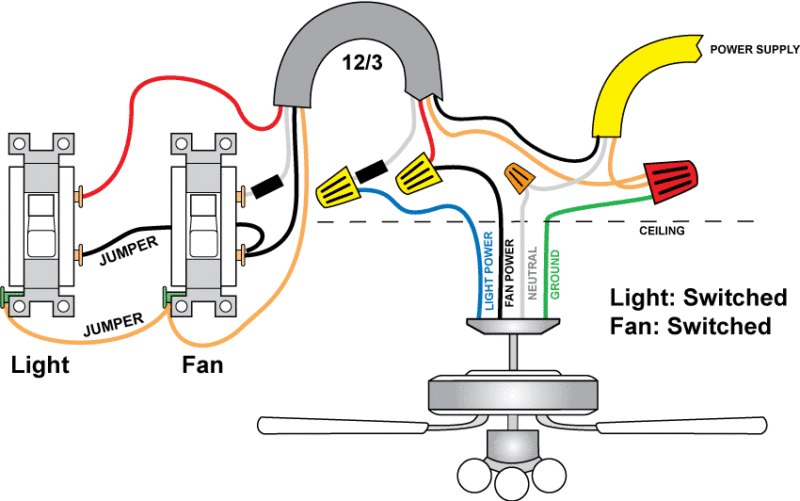
- Match your wall switch configuration to the manual’s diagrams:
– Single-switch installation: Red typically connects to black (hot)
– Dual-switch setup: Red often powers the light kit while black powers the motor
– Smart switch systems: Red may connect to receiver module terminals - Prepare wires with precision:
– Strip exactly 3/4″ of insulation using wire strippers (never teeth or knives)
– Twist strands clockwise with lineman’s pliers before capping - Secure connections properly:
– Insert wires into wire nuts until bare copper disappears
– Tug firmly to verify no strands pull loose
– Wrap connections with electrical tape for vibration resistance
When Your Red Wire Doesn’t Match the Diagram
This indicates either:
– Modified home wiring: Previous owners rerouted circuits
– Non-standard fan model: Boutique or imported units use custom schemes
– Damaged wiring: Rodents or age degraded insulation causing shorts
Do NOT force connections. Instead:
1. Trace red wire from fan to its termination point
2. Test continuity with multimeter on disconnected wires
3. Consult electrician before proceeding – this isn’t DIY territory
What to Do When You Can’t Find the Wiring Diagram
No manual? Don’t panic—but absolutely do not guess. Missing documentation turns simple wiring into a high-risk investigation. Follow this professional workflow to identify your red wire’s purpose without risking safety.
Safe Identification Process for Unknown Wiring
- Map your switch configuration:
– Single switch: Likely red = light kit (but verify)
– Two switches: One controls fan speed, the other lights
– Dimmer switches: Require compatible fan modules - Conduct voltage tests with power ON (carefully!):
– With breaker ON but fan disconnected:- Black wire should show 120V when switch is ON
- Red wire should show 120V ONLY when light switch is ON
- Blue wire often mirrors red in light circuits
- Check for hidden clues:
– Tape residue on wires indicating previous connections
– Burn marks where wires were incorrectly joined
– Wire nut colors (red = 3 wires, yellow = 2 wires)
When You Must Call a Professional Immediately
- Aluminum wiring in your home (requires special connectors)
- No ground wire in ceiling box
- Red wire shows voltage when all switches are OFF
- Previous DIY attempts with melted insulation
Licensed electricians carry circuit tracers that follow wires through walls—something no homeowner tool can replicate. For $75-$150, they’ll identify your red wire’s function in 20 minutes and prevent $10,000+ fire damage.
Preventing Future Wiring Disasters During Installation
The real danger begins when homeowners assume they’ll “figure it out later.” Proper documentation and labeling during initial installation saves future headaches and hazards. Treat every wire like a live conductor—even when the breaker’s off.
Pro Wiring Documentation Protocol
- Create a wiring map with:
- Clear photos of all connections
- Diagram showing switch positions vs. wire functions
- Breaker number and amperage noted
- Store manuals digitally:
- Scan diagrams and save to cloud storage
- Email copies to yourself with “CEILING FAN MANUAL” subject line
- Label wires at both ends:
- Use waterproof labels inside ceiling box
- Mark corresponding switches with masking tape
The 5-Second Safety Habit That Saves Lives
Before any electrical work:
1. Flip the breaker OFF
2. Test wires with voltage tester
3. Place tape over breaker with “DO NOT TURN ON – FAN WORK”
This prevents well-meaning family members from accidentally re-energizing your workspace.
Final Note: Never trust generic advice when you need to connect ceiling fan wiring red wire. That red wire could be your light kit’s lifeline or a hidden path to electrocution—only your specific fan’s diagram knows for sure. When in doubt, shut off the breaker, take photos, and call a licensed electrician. Proper wiring takes minutes with the right knowledge but could cost everything if guessed wrong. Keep your manual accessible, label every connection, and remember: the safest ceiling fan is one wired by someone who knows exactly what that red wire does in your installation. For immediate help, search your fan’s model number plus “official wiring diagram” – and never compromise on verified instructions.
Leave a Reply