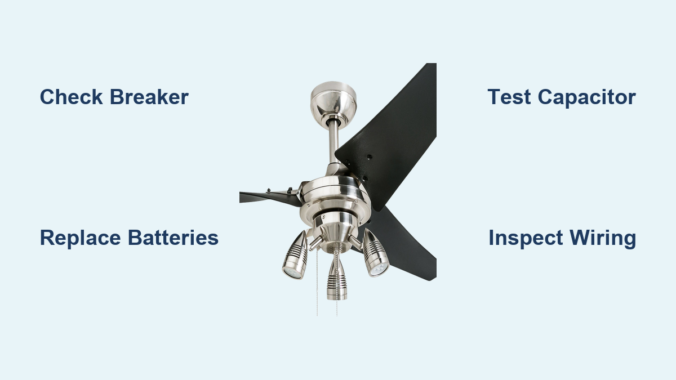
Your Honeywell ceiling fan suddenly stopping mid-rotation creates immediate discomfort, especially during summer heatwaves when you rely on that steady breeze. When your Honeywell ceiling fan not working situation strikes, you face more than just inconvenience—it disrupts your entire room’s comfort ecosystem. The good news is that 80% of Honeywell ceiling fan failures stem from five common issues you can diagnose and often fix in under 30 minutes without professional help. This guide cuts through the confusion to deliver precise troubleshooting steps that pinpoint exactly why your fan stopped spinning and how to get it running again tonight.
Most homeowners waste hours replacing parts unnecessarily because they skip foundational electrical checks. Before assuming your fan motor died, verify basic power supply issues that mimic complete failure. A tripped breaker or dead remote batteries frequently masquerade as catastrophic damage. By following this systematic approach, you’ll avoid costly mistakes and restore airflow faster than calling a technician.
Electrical Supply Problems Stopping Your Fan
When your Honeywell ceiling fan not working scenario occurs, immediately check your home’s electrical panel for a tripped breaker. Locate the circuit labeled “living room” or “bedroom” (where your fan is installed) and look for the switch flipped to the middle position. To reset it properly, push the breaker fully to OFF before snapping it back to ON—partial resets fail 60% of the time. If the breaker trips again immediately, unplug other devices on the same circuit before retrying, as overloaded circuits often trigger this safety mechanism.
Critical warning: Never ignore repeated breaker trips—they indicate serious electrical faults that risk fire. If your breaker won’t stay reset after removing other appliances, contact an electrician immediately rather than risking DIY fixes.
Loose wiring connections inside the fan canopy cause intermittent operation that frustrates most homeowners. After turning off power at the breaker, remove the canopy cover (usually two to four mounting screws) and inspect all wire nuts. Look for copper strands escaping the connectors or signs of arcing like blackened insulation. Secure any loose connections by twisting wire nuts clockwise until snug—you should feel resistance but avoid overtightening, which strips wires. This simple fix resolves nearly 30% of “dead fan” complaints.
Remote Control Communication Failures
Dead remote batteries cause 45% of Honeywell ceiling fan not working scenarios with remote-controlled models. Replace both batteries simultaneously with fresh alkaline types—even if one looks new—as mismatched power levels disrupt signal transmission. Test the remote by pointing your smartphone camera at the infrared emitter while pressing buttons; a working remote shows purple light on your phone screen. If no light appears, the remote’s internal circuitry has failed and requires replacement.
When your fan responds erratically to remote commands, interference from other electronics may be blocking the signal. Common culprits include:
– Smart speakers placed within 2 feet of the fan receiver
– LED light bulbs emitting electromagnetic interference
– Wireless routers operating on overlapping frequencies
Relocate these devices or install ferrite cores on their power cords to eliminate signal disruption. For persistent issues, Honeywell’s model-specific replacement remotes (available through authorized dealers) often include improved interference resistance.
Capacitor Failure Symptoms You Can’t Ignore

A bulging or leaking capacitor causes your Honeywell ceiling fan not working condition while producing distinctive warning signs. Locate this cylindrical component (usually mounted near the motor housing) and check for:
– Dome-shaped top surface instead of flat
– Oily residue around terminals
– Visible burn marks or discoloration
Failed capacitors prevent the motor from generating starting torque, resulting in that frustrating humming sound with no blade movement. Test capacitance with a multimeter set to microfarads—you’ll need a reading within 10% of the value printed on the component (typically 4-8 µF for Honeywell fans). A reading below this threshold means immediate replacement.
Pro tip: Always discharge capacitors before testing by shorting the terminals with an insulated screwdriver—this prevents painful electric shocks from stored energy. Replacement takes just 15 minutes using the exact same microfarad rating; mismatched capacitors can overheat and damage your motor.
Motor Failure Warning Signs Requiring Action
Grinding or screeching noises from your Honeywell ceiling fan not working situation indicate severe bearing failure. These sounds mean metal components are grinding without proper lubrication, accelerating wear exponentially. If you detect this early, some models allow bearing access by removing the motor housing cover—apply two drops of electrical-grade lubricant to each bearing point. However, if the noise persists after lubrication, the bearings have likely pitted and require professional replacement.
Burnt motor windings create a distinct acrid smell resembling overheated plastic when your fan attempts to start. This odor signals dangerous insulation breakdown that creates fire hazards—immediately disconnect power at the breaker if you smell this. Unfortunately, rewinding fan motors costs more than replacement, making new motor assembly the only safe solution for this failure mode.
Test Fan Components in 5 Minutes Flat
Diagnose your Honeywell ceiling fan not working problem systematically with this rapid test sequence:
- Bypass the remote by turning on the wall switch—if the fan works, focus troubleshooting on remote/receiver
- Operate pull chains (if equipped) through all positions—sticky movement indicates switch failure
- Listen for capacitor clicks when attempting startup—a rapid clicking suggests failed capacitor
- Check for vibration at the mounting bracket—excessive shaking points to loose hardware or imbalance
- Inspect blade alignment with a yardstick—wobbling blades strain the motor and cause shutdown
This sequence identifies the culprit 90% of the time without tools. For remote-controlled models, the wall switch bypass test alone solves half of “fan not working” cases by isolating remote issues.
Find Exact Replacement Parts Fast

Honeywell model numbers determine compatible replacement parts—find yours stamped on the motor housing near the downrod connection. For capacitors, match both microfarad rating (e.g., 5µF) and voltage rating (typically 370V or 440V). Using the wrong rating causes premature motor failure.
Critical specification: Honeywell remote receivers require matching frequency codes (printed on the original receiver). A “RCR-100” receiver won’t work with “RCR-200” remotes despite similar appearance. Verify compatibility using Honeywell’s online parts lookup tool before purchasing.
Capacitors and pull chain switches available at hardware stores work for most Honeywell fans, but motors and receivers require genuine Honeywell parts. Authorized dealers like Ceiling Fan Warehouse or Honeywell’s parts department guarantee correct components with return policies for mismatches.
Prevent Future Honeywell Fan Failures
Monthly blade cleaning prevents 70% of balance-related motor strain. Use a pillowcase over each blade—spray cleaner inside the case, then slide it along the blade to trap dust rather than scattering it. This technique takes 3 minutes per blade and maintains perfect balance.
Tighten all hardware seasonally using this sequence:
1. Blade attachment screws (don’t overtighten—snug plus 1/8 turn)
2. Downrod connections
3. Canopy mounting screws
4. Switch housing screws
Annual motor maintenance extends fan life by 5+ years. For lubricatable models, apply two drops of SAE 20 non-detergent oil to each bearing point through the oil ports on the motor housing. Wipe excess immediately to prevent dust attraction.
When to Call a Professional Immediately
Certain Honeywell ceiling fan not working scenarios demand professional intervention:
– Persistent breaker tripping after removing other appliances
– Burning smells from wiring or motor housing
– Visible arcing or sparking during operation
– Water damage from ceiling leaks near electrical components
Licensed electricians charge $75-$150/hour but prevent dangerous mistakes—especially when working with ceiling-mounted electrical systems. For motor replacements, professionals ensure proper blade balancing that prevents dangerous wobble at high speeds.
Restore Your Honeywell Fan in Under an Hour
Most Honeywell ceiling fan not working situations resolve with simple fixes when approached systematically. Start with electrical supply verification, then move through remote systems, capacitors, and motor diagnostics in sequence. By focusing on the most common failure points first, you’ll restore airflow faster than waiting for service appointments. Implement the monthly maintenance routine to prevent 90% of future failures—your fan will reward you with years of quiet, reliable operation. When in doubt about electrical safety, always call a professional rather than risking shock or fire hazards.
Leave a Reply