You’ve probably never given much thought to the quiet hum above your head as your ceiling fan keeps you comfortable through hot summer days and redistributes warm air in winter. Yet inside that seemingly simple fixture lies an elegant application of electromagnetic principles that has remained fundamentally unchanged for nearly two centuries. Understanding how a ceiling fan motor works reveals why these devices deliver reliable air circulation with minimal energy consumption—typically drawing just 50-100 watts at high speed compared to hundreds of watts for air conditioning. Whether you’re troubleshooting a malfunctioning fan, selecting a new energy-efficient model, or simply curious about the technology overhead, this guide explains every aspect of ceiling fan motor operation in clear, practical terms that help you make informed decisions about installation, maintenance, and repair.
Electromagnetic Principles Powering Your Fan
Faraday’s Discovery in Everyday Operation
Every ceiling fan motor relies on Michael Faraday’s 1830s discovery of electromagnetic induction—the bidirectional relationship between electricity and magnetism. When household current reaches your fan motor, it flows through copper windings surrounded by iron cores, creating magnetic fields that interact to produce rotational force. This elegant physics principle converts electrical energy into the mechanical motion that spins your fan blades, creating the airflow that keeps your rooms comfortable.
The rotating magnetic field within your fan motor is carefully engineered through strategically sequenced currents in stationary coils called stator windings. Unlike industrial motors that spin at thousands of RPM, ceiling fans operate at a deliberate 80-350 RPM to optimize air movement efficiency while minimizing noise. This slower rotation is intentional design rather than a limitation, allowing your fan to move substantial air volumes with remarkably little power—typically less than $5 worth of electricity per year for regular use.
Visualizing the Rotating Magnetic Field

Your ceiling fan creates the illusion of a rotating magnetic field without any physical components actually moving. By precisely timing electrical currents through multiple stator windings, the motor generates a magnetic field that appears to rotate around the stationary housing. This clever electromagnetic trick pulls the rotor along with it, creating continuous torque that spins your fan blades.
What to look for: If your fan hums but won’t start, this usually indicates a failure in creating the proper rotating field—often due to a faulty capacitor (more on this later). The characteristic 120Hz hum you sometimes hear comes from magnetic forces deforming the stator and rotor components during each AC cycle, a normal phenomenon in quality installations.
Single-Phase Induction Motors: 90% of Ceiling Fans Explained
Overcoming the Starting Challenge
The single-phase induction motor powers approximately 90% of residential ceiling fans worldwide, yet faces a fundamental problem: it can’t start rotating on its own from standstill. Household AC power creates a pulsating rather than truly rotating magnetic field at startup, which won’t generate the necessary torque. Ceiling fan engineers solved this through two clever approaches:
- Shaded-pole design: Uses copper rings around portions of each pole to create delayed magnetic fields
- Capacitor-start configuration: Creates phase shift in starting windings for stronger initial torque
Most modern fans use capacitor-start designs because they provide more reliable startup, especially in humid conditions or with dust accumulation. The capacitor creates the necessary phase difference between windings to produce that initial rotational push, after which the motor sustains operation through electromagnetic induction alone.
The Squirrel Cage Rotor’s Simplicity
Inside your induction motor sits the remarkably simple yet effective squirrel cage rotor—a cylindrical arrangement of aluminum or copper bars connected at both ends. When the rotating magnetic field passes these conductive bars, it induces eddy currents that interact with the magnetic field to produce rotational force. This design requires no electrical connections to the moving parts, eliminating brushes and commutators that would wear out over time.
Pro tip: The slight speed difference between the rotating magnetic field and the actual rotor speed (called “slip”) is essential for torque production. Quality fans maintain 5-10% slip at rated load—too little slip reduces torque, while too much decreases efficiency.
Brushless DC Motors: The Future of Ceiling Fan Technology
Electronic Commutation Replaces Mechanical Parts
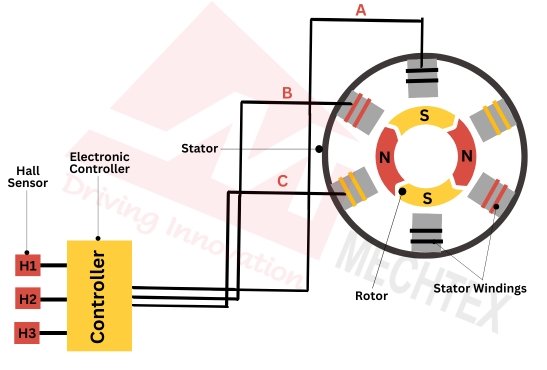
Brushless DC (BLDC) motors represent the most significant advancement in ceiling fan design over the past two decades, eliminating the brushes and commutators found in traditional motors. Instead, an integrated electronic controller precisely regulates speed by modulating electrical waveforms delivered to the stator windings. This technology enables features like:
- Multiple precise speed settings
- Reversible rotation without mechanical switches
- Remote control integration
- Breeze simulation modes that vary speed naturally
BLDC motors convert household AC power to DC through an internal power module, then use sensors or sensorless detection to determine rotor position. The controller energizes stator phases in sequence to create the rotating magnetic field that pulls the permanent magnet rotor along—without any physical contact between moving and stationary parts.
Why BLDC Motors Save You Money
While BLDC ceiling fans often cost slightly more upfront, they deliver 20-30% higher efficiency than traditional induction motors—translating to 10-20 watts of actual power savings during continuous operation. A typical BLDC motor achieves 65-75% efficiency compared to 50-60% for equivalent induction motors, meaning more of your electricity goes toward moving air rather than generating heat.
Time estimate: Over 10,000 hours of operation (about 7 years of regular use), a BLDC fan can save $15-$30 in electricity costs compared to traditional models—enough to offset the initial price difference while providing quieter operation and longer service life.
Stator Assembly: The Stationary Power Generator

Laminated Core Construction
The stator forms the stationary heart of your ceiling fan motor, consisting of laminated steel cores (typically 0.35-0.5mm thick) with copper windings wrapped around protruding teeth. These thin laminations, coated with insulating varnish and stacked precisely, reduce eddy current losses that would otherwise waste energy as heat.
High-quality motors use windings with higher copper content and more precise winding techniques to minimize electrical resistance. The stator housing—usually die-cast aluminum—provides structural support while facilitating heat dissipation. Aluminum’s superior thermal conductivity keeps the motor cooler, extending insulation life and preventing premature failure.
Warning: Excessive dust buildup on your fan motor acts as insulation, trapping heat and accelerating temperature rise. Clean your fan housing every 3-6 months with a soft brush to maintain optimal thermal performance and prevent unnecessary strain on the motor.
Capacitors: The Secret to Smooth Starting

Start vs. Run Capacitors Explained
Capacitors play a critical role in your ceiling fan’s operation by altering the electrical phase relationship between different winding sets. Two types work together:
- Start capacitor: Provides high phase shift for initial torque generation (designed for intermittent duty)
- Run capacitor: Maintains improved efficiency during continuous operation (designed for continuous duty)
Start capacitors connect through a centrifugal switch that disconnects them once the motor reaches operating speed—essential protection since these components would overheat rapidly if energized continuously. Run capacitors have lower capacitance values optimized for efficiency rather than starting torque.
Diagnosing Capacitor Failure
Capacitor problems cause the most common ceiling fan malfunctions—you might hear humming without rotation, notice reduced starting reliability, or experience intermittent operation. Testing requires a multimeter to check capacitance values against specifications printed on the component.
Common mistake: Replacing a failed capacitor with one of different capacitance or voltage rating. Always match specifications exactly—incorrect values can cause motor overheating, reduced torque, or premature failure. Quality replacement capacitors cost $5-$15 and take 10 minutes to install with basic tools.
Reversing Switch Mechanics: Summer vs. Winter Modes
Changing the Magnetic Field Direction
Your fan’s reversing switch works by altering the phase relationship between windings to reverse the rotating magnetic field direction. When you flip the switch (usually a small slider on the fan housing), it swaps connections to the start winding relative to the run winding, causing the magnetic field to rotate in the opposite direction.
This simple mechanical change creates dramatically different airflow patterns:
– Downward rotation (summer mode): Creates a cooling breeze directly beneath the fan
– Upward rotation (winter mode): Circulates warm air trapped near the ceiling
Expert note: BLDC motors achieve reversing electronically through the controller rather than a mechanical switch, eliminating a potential failure point and enabling smoother transitions between directions—just one reason newer smart fans often operate more reliably long-term.
Keeping Your Ceiling Fan Motor Quiet and Efficient
Identifying and Solving Noise Problems
Motor noise in ceiling fans comes from three primary sources:
1. Electromagnetic hum (normal 120Hz sound from magnetic forces)
2. Bearing friction (progresses from subtle whine to grinding as wear develops)
3. Aerodynamic blade noise (increases with fifth power of tip speed)
New or well-maintained bearings produce virtually silent operation, while advanced degradation creates distinctive grinding or clicking sounds. Sleeve bearings may benefit from occasional oiling through designated ports, while sealed ball bearings require no lubrication but eventually need replacement.
Prevention tip: Balance your fan blades annually using a balancing kit—improper balance causes vibration that accelerates bearing wear and creates annoying resonance. Even small imbalances (measured in gram-centimeters) become noticeable at operating speeds.
Smart Ceiling Fans: How Technology is Changing Motor Design
BLDC Integration with Home Automation
Modern smart ceiling fans increasingly incorporate BLDC motors with wireless connectivity for smartphone control and voice assistant integration. These systems use advanced algorithms to optimize operation based on multiple inputs:
- Indoor and outdoor temperature
- Humidity levels
- Occupancy sensors
- HVAC system status
The controllability of BLDC motors enables features impossible with traditional designs, including precise speed control down to 1 RPM increments and rapid acceleration/deceleration for natural-feeling breeze patterns. Machine learning approaches even allow systems to adapt to your preferences over time, automatically adjusting for optimum comfort with minimal user intervention.
Energy impact: Smart fans with occupancy sensors activate only when people are present, while temperature-based controls reduce speed as indoor temperatures approach comfort levels—potentially cutting fan energy use by 30-50% compared to manual operation.
Understanding how a ceiling fan motor works reveals why these simple devices deliver decades of reliable service with minimal maintenance. From the electromagnetic principles discovered nearly two centuries ago to the sophisticated BLDC technology in modern smart fans, the core function remains consistent: converting electricity into controlled rotation that moves air efficiently. When selecting a new fan, prioritize BLDC motor technology for superior efficiency, quieter operation, and advanced features that integrate with your smart home ecosystem. For existing fans, regular cleaning and occasional lubrication (for sleeve bearing models) will keep your motor spinning smoothly for years to come—proving that sometimes, the most unassuming technology overhead represents remarkable engineering worth appreciating.
Leave a Reply