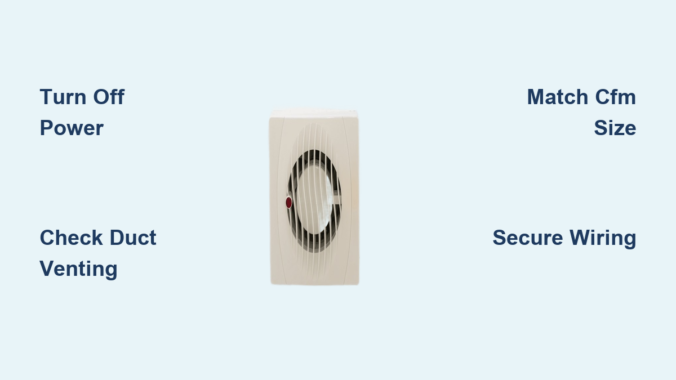
A malfunctioning bathroom exhaust fan can lead to lingering humidity, fogged mirrors, and even mold growth behind walls. If your fan runs poorly, makes loud noises, or does not work at all, it may be time for a replacement. This guide walks you through every step, from diagnosing the issue to testing your new fan and ensuring code-compliant venting that lasts for years.
You will learn how to choose the right model based on CFM and noise ratings, work safely with electricity, and determine whether you need a simple motor swap or a full unit upgrade. Whether you are doing a quick fix or a complete renovation, these step-by-step instructions will help you complete the job correctly.
Diagnose the Problem Before Replacing
Before tearing into your ceiling, confirm whether the fan needs full replacement or just a simple fix. Many homeowners assume the motor is dead when the real issue is something much simpler.
Test the Wall Switch First
Test the wall switch by plugging a working device like a hair dryer into an outlet on the same circuit. Flip the switch. If the device does not turn on, the switch is faulty. Replacing a switch takes less than 30 minutes and costs under $20.
Check Power at the Fan Housing
Turn off the circuit breaker, remove the fan grille, and disconnect the wiring. Use a voltage tester to verify power reaches the housing when the switch is on. No voltage means the issue could be a tripped GFCI, loose wire, or faulty circuit. Always confirm the power is off before touching wires.
Inspect the Motor, Blades, and Duct
If power reaches the fan but it still will not run, the motor is likely burned out. Also check for duct blockages including lint, bird nests, and kinks. Inspect the flapper valve, which should open freely and seal tightly. Clean fan blades if they are caked with dust. A weak airflow often means a clogged duct, not a failing motor.
Choose Between Motor Swap and Full Replacement

Your next move depends on the condition of the existing housing and what you want to achieve.
When to Replace Just the Motor Module
If the housing is intact and the model is modular, you can swap the motor in under 10 minutes. This approach is ideal for older NuTone or Broan fans with plug-in connectors. It is the most budget-friendly fix.
The steps are straightforward. Pinch the spring clips and lower the grille. Unplug the motor from the electrical connector. Press the tabs and lift out the old module. Insert the new one and snap the grille back into place. Compatible modules are available even for 25-year-old units.
When to Install a Complete New Fan
Choose a full replacement if the housing shows damage, corrosion, or dry rot. This approach is also best when no compatible replacement motor exists or when you want to upgrade features like integrated lighting, heaters, or smart controls. Popular models include Panasonic WhisperFit, NuTone with LED light, and Hampton Bay units available at home improvement stores.
Select the Right CFM and Noise Level

Choosing the wrong fan leads to poor performance or wasted energy. The two most important specifications are CFM and sones.
Calculate Required CFM
The basic rule is 1 CFM per square foot of bathroom space. For example, a 6 foot by 8 foot bathroom equals 48 square feet and requires at least 50 CFM. The advanced formula multiplies floor area by ceiling height by 0.13. Using this method, a 70 square foot bathroom with 8 foot ceilings needs roughly 73 CFM, rounded up to 75.
Add 50 CFM if the room has a tub or shower. Add 100 CFM for whirlpool or steam showers. Bathrooms under 50 square feet require a minimum of 50 CFM regardless of the calculation.
Prioritize Low Sones for Quiet Operation
A noisy fan gets turned off, which defeats the purpose. Aim for under 1.0 sone for whisper-quiet operation, ideal for master bathrooms. Under 2.0 sones is comfortable for daily use. Anything over 4.0 sones is noticeably loud. Panasonic DC-motor fans run as low as 0.3 sones, quieter than a library.
Look for Energy-Efficient Features
Look for ENERGY STAR certification, which uses up to 70% less energy. DC motors are more efficient and quieter than AC motors. Humidity sensors auto-run the fan when moisture rises. LED lighting provides long-lasting, low-heat illumination. Heater combos are great for cold climates.
Gather Tools and Prepare for Installation
Having the right tools and materials before starting prevents multiple trips to the store.
Essential Tools Needed
You will need a stable step ladder, a voltage tester, Phillips and flat-head screwdrivers, needle-nose pliers, a drill or driver, a jab saw for drywall cuts, and a measuring tape.
Materials List
Purchase a replacement fan or motor module, wire nuts, foil tape for sealing duct joints, flexible insulated ducting, zip ties for securing connections, a protective grommet if no cable clamp exists, silicone caulk for sealing edges, and drywall scraps with joint compound for patching if needed. Never use duct tape, as it fails over time.
Turn Off Power and Remove the Old Fan
Safety is the top priority. Never skip these verification steps.
Shut Off the Correct Circuit Breaker
Go to your electrical panel and turn off the bathroom fan circuit. Label the breaker to prevent accidental reactivation while you work.
Verify Power Is Off
Use a non-contact voltage tester at the fan housing. Test both wires, because even a non-working fan could still have live current present. This simple step prevents serious injury.
Remove the Grille and Disconnect Everything
Pinch the spring clips on either side and gently pull the grille down. Set it aside. Disconnect the exhaust duct from the housing. Remove the wire nuts connecting black to black, white to white, and ground to ground. Remove the mounting screws securing the housing to the joists. Carefully lower the unit through the ceiling. Tape exposed wire ends to prevent accidental contact.
Prepare the Installation Area
With the old fan removed, assess the opening and make necessary adjustments.
Measure and Modify the Ceiling Opening
Compare the old fan cutout size to the new unit specifications. Most fans use a 7.5 inch by 7.5 inch square or an 11 inch round opening. Use a jab saw to enlarge the hole if the new fan is larger. Patch gaps with drywall scraps and joint compound if the new fan is smaller. If you have no attic access, consider a roomside no-cut model.
Inspect Joists and Duct Path
Check the framing for dry rot or mold. Look for pest damage from rodents or insects. Inspect the duct condition and replace kinked or torn flex duct with smooth, insulated ducting. The duct must vent outside, never into the attic or soffit.
Install the New Fan Housing
Mounting methods differ between new construction and retrofit installations.
Choose the Right Mounting Approach
New construction fans use built-in rails that screw directly into joists. Retrofit fans drive screws through metal flanges into joists. Add wood blocking between joists if mounting points do not align with existing framing.
Connect the Duct Properly
Attach flexible duct to the fan collar. Route the duct short and straight to the exterior vent. Avoid sharp bends because each 90-degree turn reduces airflow by 25 percent. Seal all joints with foil tape and secure with zip ties. Insulate ducting in unconditioned spaces like attics to prevent condensation.
Wire the New Fan Correctly
Electrical connections follow a standard color code.
Standard Wiring Connections
Connect black to black, white to white, and ground to green or bare copper. Use wire nuts to secure all connections. If the fan lacks a cable clamp, install a protective grommet where the wire enters the housing. Some fans like Panasonic models use quick-connect terminals that require no wire nuts. Tuck wires neatly into the housing.
Ensure Proper Grounding
The housing must be properly grounded for safety. If the old box lacks a ground wire, hire an electrician rather than bypassing this critical safety feature.
Complete Final Assembly and Test
The installation is almost complete. Follow these final steps to ensure everything works properly.
Secure the Unit and Attach the Grille
Insert the fan module into the housing, being careful not to pinch wires. Attach with the provided screws and double-check all connections. Reconnect the exhaust duct using zip ties. Align the grille and press until it clicks. For older models, reattach with screws. Do not overtighten because plastic grilles crack easily.
Test Airflow and Operation
Turn the breaker back on and flip the wall switch. The fan should start smoothly, run quietly, and vibrate minimally. Hold a tissue near the grille, which should stick instantly due to strong airflow. Go outside and feel air exiting the roof or wall cap within seconds. Apply silicone caulk around the grille perimeter to prevent air leaks. If equipped, run a hot shower to test the humidity sensor.
Know When to Call a Professional
Some situations require licensed expertise rather than DIY attempts.
Hire an Electrician If
Call an electrician if there is no ground wire in the box, if knob-and-tube or cloth-covered wiring is present, if the circuit lacks GFCI protection, if you need a new electrical run, or if you are adding a heater or smart system.
Hire an HVAC Technician For
Hire an HVAC tech for complex duct routing, roof vent installation, or attic access with insulation challenges. Professional installation typically costs between 200 and 500 dollars but ensures code compliance and long-term reliability.
Maintain Your Fan for Long Life
A well-maintained fan lasts 15 to 20 years. Perform maintenance every six months and annually.
Routine Maintenance Schedule
Every six months, clean fan blades with a soft brush or vacuum. Wipe down the grille with mild soap. Check the flapper valve for smooth operation. Annually, inspect ductwork for kinks or blockages. Test the humidity sensor if equipped. Re-caulk the grille if air leaks appear. Label the fan model and install date on the housing for future reference.
Recommended Models by Budget and Features
Best Overall: Panasonic WhisperFit DC
This model offers 80 to 110 CFM, operates at just 0.3 sones, and includes ENERGY STAR certification with optional humidity sensor. It delivers quiet, efficient performance.
Best Budget: Hampton Bay 70 CFM
This unit costs between 80 and 120 dollars, runs at 4.0 sones, and offers easy retrofit installation. It is widely available at home improvement stores.
Best Upgrade: NuTone 80 CFM with LED and Bluetooth
This model includes integrated lighting, app-controlled fan speed, and a modern look. It combines ventilation with convenience features.
Best for Cold Climates: Whisper Cozy Fan Heater Combo
This unit provides 70 CFM combined with a 1,500 watt heater for instant warmth after showers. It is ideal for cold bathrooms.
Frequently Asked Questions About Replacing a Bathroom Exhaust Fan
How do I know if my bathroom fan needs replacing?
Signs include poor airflow where mirrors stay fogged for more than a minute after showering, noticeably increased noise during operation, or no airflow at all when the fan is turned on. A fan that is 15 to 20 years old is also a candidate for replacement.
Can I replace just the motor instead of the whole fan?
Yes, if the housing is intact and your model uses a modular design. Many Broan and NuTone fans allow motor replacement in under 10 minutes. This approach saves money and time when the housing is in good condition.
What CFM rating do I need for my bathroom?
Calculate required CFM by using 1 CFM per square foot of floor space. A 50 square foot bathroom needs at least 50 CFM. Add 50 CFM for tubs or showers and 100 CFM for whirlpool or steam showers.
How long does it take to replace a bathroom exhaust fan?
A motor swap takes about 10 minutes. A full unit replacement with no complications takes 3 to 4 hours. If attic work or drywall patching is needed, plan for 6 to 8 hours.
Do I need an electrician to install a bathroom fan?
You may need an electrician if the existing wiring lacks a ground wire, uses outdated knob-and-tube construction, or lacks GFCI protection. Adding heaters or smart controls also typically requires professional installation.
Key Takeaways for Replacing Your Bathroom Exhaust Fan
Replacing a bathroom exhaust fan is a smart investment in your home is health and longevity. The key steps are choosing the right CFM based on your bathroom size, prioritizing low sones for quiet operation, and venting to the outside never into the attic. Seal all duct joints with foil tape and insulate ducting in unconditioned spaces. Use modular replacement when the housing is intact for a fast, affordable fix. Replace the entire unit if the housing is damaged or when upgrading to features like humidity sensors and LED lighting. With proper installation and routine maintenance, your new fan will keep bathrooms dry, odor-free, and mold-resistant for years to come.
Leave a Reply