
Choosing the right CFM for a bathroom exhaust fan isn’t just about removing steam after a hot shower. It’s about protecting your home from mold, mildew, and long-term moisture damage that can warp wood, ruin drywall, and compromise your health. CFM (Cubic Feet per Minute) measures how much air your fan can move, and selecting the correct rating ensures your bathroom gets eight complete air changes per hour, the standard needed to control humidity effectively. This guide breaks down exactly how to calculate the right CFM based on your bathroom’s size, ceiling height, fixtures, and ventilation needs so you can make a smart, code-compliant choice.
Calculating CFM Using Square Footage
The size of your bathroom is the first factor in determining the right CFM. Different rules apply depending on whether your space is small, medium, or large.
The 1 CFM Per Square Foot Rule
For bathrooms 100 square feet or smaller with standard 8-foot ceilings, the calculation is straightforward. You need 1 CFM for every square foot of floor space. This ensures eight air changes per hour, which is the benchmark for effective moisture control.
For example, a 5 ft × 7 ft bathroom equals 35 square feet, but you should install a minimum 50 CFM fan since anything below 50 CFM is considered inadequate for bathrooms under 50 square feet. A 7 ft × 10 ft bathroom (70 sq ft) requires at least a 70 CFM fan, while a 10 ft × 10 ft bathroom needs 100 CFM.
Minimum CFM Thresholds by Bathroom Size
Use these minimums as your baseline when selecting a fan.
- Less than 50 square feet: 50 CFM minimum
- 50 to 100 square feet: 1 CFM per square foot
- Over 100 square feet: Use fixture-based calculation (see below)
Adjusting CFM for High Ceilings
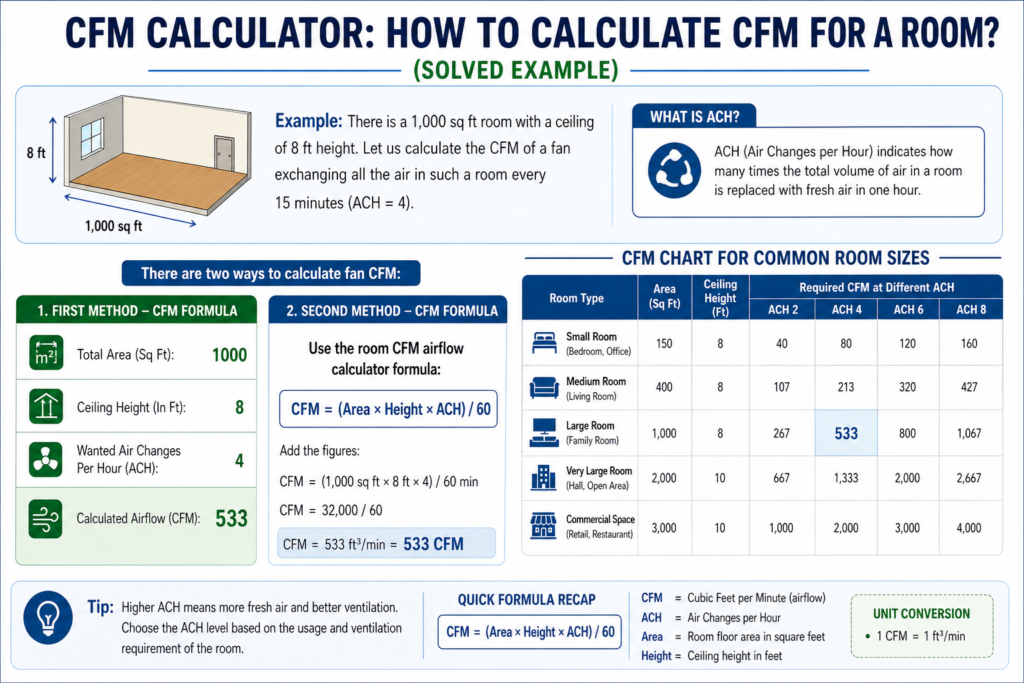
Standard formulas assume 8-foot ceilings, but many modern homes feature taller ceilings that increase the total air volume in the bathroom.
Volume-Based CFM Calculation
When ceiling heights exceed 8 feet, calculate CFM based on total room volume instead of just floor area. Multiply length × width × height × 0.13 to get your required CFM.
For a bathroom measuring 12 ft × 7 ft × 9 ft, you would calculate 12 × 7 × 9 × 0.13, which equals 98.28 CFM, so select a fan rated for at least 100 CFM. A 15 ft × 12 ft × 10 ft bathroom requires 234 CFM, meaning you need a fan rated for 235 to 240 CFM.
This method accounts for increased air volume due to higher ceilings and provides a much more accurate CFM requirement than square-footage-only estimates.
CFM Requirements for Large Bathrooms

In bathrooms over 100 square feet, ventilation requirements are often determined by the number and type of plumbing fixtures rather than floor area alone.
Fixture-Based Calculation Method
Add up the CFM values for each major fixture in your bathroom.
- Toilet: 50 CFM
- Shower: 50 CFM
- Bathtub: 50 CFM
- Jetted tub or whirlpool: 100 CFM
A bathroom with a shower and toilet needs a minimum of 100 CFM (50 + 50). A master bathroom with a jetted tub, shower, and toilet requires 200 CFM minimum (100 + 50 + 50). This approach ensures adequate ventilation even if your room is large but sparsely used, or if certain fixtures generate significantly more steam.
Selecting the Right Fan Type
Different fan types affect how CFM is delivered and experienced in your bathroom.
Ceiling-Mounted Fans
These are the most common option, installed directly in the ceiling drywall. They often combine with lighting fixtures and are suitable for standard bathrooms with CFM ratings typically ranging from 50 to 110. Ensure your duct run is short and straight for optimal airflow.
Inline Fans
Installed remotely in attics or crawlspaces, inline fans connect via ductwork to ceiling or wall grilles. They offer quieter operation because the motor is distant from your living space. These fans can handle high CFM (200 or more), making them ideal for large bathrooms or serving multiple bathrooms from one unit.
Wall-Mounted Fans
Use these when ceiling installation isn’t feasible. They can vent directly outside, reducing duct resistance and making them effective for retrofitting older homes.
Important Features Beyond CFM
While CFM determines airflow capacity, other specifications influence overall effectiveness and comfort.
Noise Level Matters
Exhaust fan noise is measured in sones, with lower ratings indicating quieter operation. A 0.5 sone fan sounds like rustling leaves (very quiet), while 1.0 sone resembles a refrigerator hum and is ideal for residential bathrooms. Fans rated above 4.0 sones sound like standard TV volume, which most homeowners find too loud for bathroom use. Choose a fan with 1.0 sone or less for quiet, unobtrusive operation.
Look for HVI Certification
The Home Ventilating Institute (HVI) tests and certifies residential ventilation products. HVI-certified fans have undergone independent laboratory testing to verify their published CFM, sone, and static pressure performance. Always look for the HVI-certified label when purchasing a bathroom exhaust fan to ensure you’re getting accurate performance ratings and not misleading claims.
Energy Efficiency Benefits
Energy Star-certified bathroom fans meet strict efficiency standards set by the EPA. These fans use up to 70% less energy than conventional models while meeting maximum sound output requirements based on their CFM rating. They’re ideal for homeowners seeking energy savings and long-term reliability.
Installation for Maximum CFM Delivery
Proper installation is critical to achieving rated CFM performance in your actual bathroom.
Ducting Best Practices
Vent your fan to the exterior only. Never vent into attics, crawl spaces, or wall cavities, as this leads to condensation, mold, and structural damage. Use rigid or semi-rigid ducting instead of flexible plastic ducts, which create airflow resistance and reduce effective CFM. Minimize duct length and bends since each 90-degree bend can reduce airflow by 25 to 30 percent. Seal all joints with foil tape or mastic to prevent air leaks.
Verify Proper Setup
Confirm airflow direction matches your duct layout and ensure the exterior vent cap is clear of debris. For complex installations with long duct runs or inline fans serving multiple bathrooms, consult a licensed HVAC contractor.
Common Mistakes to Avoid
Several errors can lead to inadequate ventilation even with the correct CFM fan.
Under-Sizing Your Fan
Choosing a fan with too little CFM leads to persistent humidity, fogged mirrors, and long-term structural damage. Always calculate your actual requirements rather than grabbing the cheapest option.
Ignoring Ceiling Height
Using square footage alone for bathrooms with 9-foot or taller ceilings drastically underestimates your needs. Always use the volume-based calculation for non-standard ceiling heights.
Poor Duct Installation
A high-CFM fan won’t perform if connected to long, flexed, or leaky ductwork. Professional installation ensures you actually get the rated airflow.
Frequently Asked Questions About Choosing Bathroom Fan CFM
What happens if I choose a CFM that’s too low for my bathroom?
A fan with insufficient CFM won’t remove moisture quickly enough, leading to fogged mirrors, persistent humidity, and eventually mold growth. Long-term, inadequate ventilation can damage drywall, warp wood, and compromise your indoor air quality.
Can I oversize my bathroom exhaust fan?
Slight over-sizing (10 to 20 percent above calculated need) is acceptable and can improve moisture removal without significant energy penalty. However, excessively oversized fans may cause negative pressure in tightly sealed homes, which can interfere with combustion appliances or reduce efficiency.
Do I need a different CFM for a bathroom with just a toilet versus one with a shower?
Yes. A toilet requires 50 CFM while a shower needs 50 CFM. If your bathroom has both, you need at least 100 CFM. Showers generate significantly more steam and moisture than toilet use, so factor in your actual fixture types when calculating requirements.
How do I calculate CFM for a bathroom with 10-foot ceilings?
Use the volume-based formula: Length × Width × Height × 0.13. For a 10 ft × 8 ft × 10 ft bathroom, multiply 10 × 8 × 10 × 0.13, which equals 104 CFM, so select a fan rated for at least 105 to 110 CFM.
What’s the minimum CFM for a small powder room?
Even for bathrooms under 50 square feet, install a minimum of 50 CFM. The 1 CFM per square foot rule has this floor minimum to ensure effective moisture removal in compact spaces.
Key Takeaways for Selecting the Perfect CFM
Choosing the correct CFM for your bathroom exhaust fan comes down to three main factors. First, calculate using square footage (1 CFM per sq ft) for standard 8-foot ceilings in bathrooms under 100 square feet. Second, use volume-based calculation (length × width × height × 0.13) for bathrooms with ceilings over 8 feet tall. Third, apply fixture-based calculation for large bathrooms over 100 square feet by adding 50 CFM for each toilet, shower, or bathtub, and 100 CFM for jetted tubs.
Beyond CFM, prioritize HVI-certified fans with low sone ratings (1.0 or less) for quiet operation. Ensure proper ducting and exterior venting to maintain effective airflow. Consider features like humidity sensors or timers for automatic operation that ensures complete air exchange even after you’ve left the bathroom. By following these guidelines, you’ll select a bathroom exhaust fan that effectively manages moisture, protects your home, and operates quietly for years to come.
Leave a Reply