Is your bathroom still foggy after a hot shower? Does cooking leave lingering smoke and odors in your kitchen? Choosing the correct exhaust fan size prevents these frustrating ventilation problems and protects your home from mold, moisture damage, and poor air quality. The key measurement you need is CFM (Cubic Feet per Minute), which tells you exactly how much air a fan can move.
This guide walks you through calculating the right exhaust fan size for any room. You will learn proven CFM formulas, room-specific requirements, and how to account for ductwork that can reduce airflow. By the end, you will know exactly what size fan your bathroom, kitchen, laundry room, or workshop needs.
Calculate Required CFM Using Room Volume
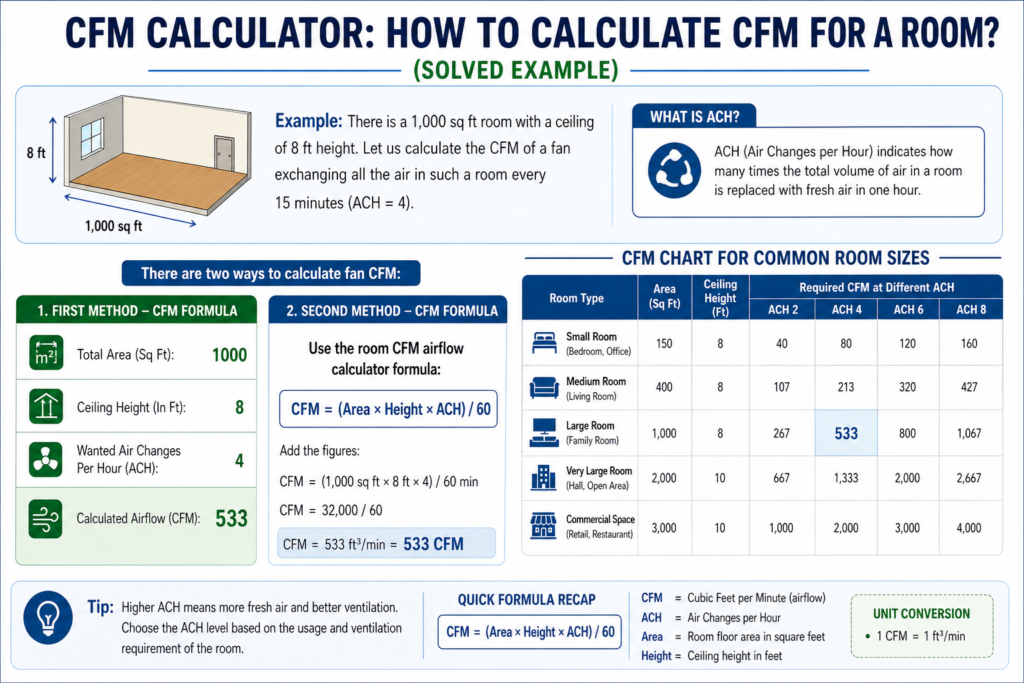
The most accurate way to determine exhaust fan size starts with knowing your room’s total air volume. This method uses Air Changes per Hour (ACH), which represents how many times the entire room air should be replaced each hour.
Use the Air Changes Per Hour Formula
Different rooms need different air exchange rates based on moisture levels and activity. Multiply your room’s cubic footage by the recommended ACH, then divide by 60 to get CFM.
CFM Formula: (Length × Width × Height × ACH) ÷ 60
For a 10 ft × 12 ft bathroom with 8 ft ceilings, the calculation works like this:
• Room volume equals 10 × 12 × 8, which equals 960 cubic feet
• Bathrooms need 8 air changes per hour
• CFM equals (960 × 8) ÷ 60, which equals 128 CFM
Always round up to the nearest standard fan size, so choose a 130 CFM fan.
Apply the Quick 0.13 Rule for Bathrooms
Save time with this widely-used shortcut specifically for bathrooms. Since 8 ACH divided by 60 equals approximately 0.13, you can multiply your room volume directly by 0.13.
CFM = Room Volume × 0.13
This shortcut delivers the same result as the full formula and works perfectly for standard residential bathrooms with 8-foot ceilings.
Size Exhaust Fans by Room Type
Every room in your home has unique ventilation demands. Matching fan performance to actual use ensures effective moisture removal and air quality.
Calculate Bathroom Fan Size
For bathrooms under 100 square feet, use 1 CFM per square foot as your baseline. An 8 ft × 10 ft bathroom needs at least 80 CFM.
For larger bathrooms over 100 square feet, add extra CFM for each fixture:
• Toilet: add 50 CFM
• Shower: add 50 CFM
• Bathtub: add 50 CFM
• Jetted tub: add 100 CFM
A large bathroom with a shower and jetted tub needs at least 150 CFM regardless of square footage. The industry standard requires replacing bathroom air 8 times per hour, or roughly every 7.5 minutes, to prevent mold and condensation.
Determine Kitchen Fan Size
Kitchens demand stronger ventilation to clear grease, smoke, and cooking odors. Electric stoves need a minimum of 100 CFM, while gas stoves require 100 CFM per 10,000 BTU of burner output.
A gas range with 40,000 BTU needs 400 CFM. Always choose ducted (vented) range hoods over ductless recirculating models for superior performance. Island hoods or kitchens with high ceilings may need 20 to 50 percent more CFM to maintain effectiveness.
Size Laundry Room and Workshop Fans
Laundry rooms need at least 50 CFM to control moisture from drying clothes. Heavy-use or shared laundry spaces benefit from 80 to 100 CFM. Gas dryers require additional ventilation to prevent carbon monoxide buildup.
Workshops and garages need aggressive air exchange, targeting 8 to 12 air changes per hour. A 20 ft × 20 ft garage with 10 ft ceilings needs approximately 667 CFM based on 10 ACH. Choose a 700 to 800 CFM fan or a multi-fan system for these high-demand spaces.
Apply the 1 CFM Per Square Foot Rule
For quick estimates in rooms with standard 8-foot ceilings, this rule provides a fast starting point. Multiply the room’s square footage by one to get the minimum CFM.
This method works well for:
• Bathrooms under 100 square feet
• Home offices
• Bedrooms
• Living areas
A 120 square foot bedroom needs roughly 120 CFM. This rule assumes standard ceiling height and moderate use. Increase CFM for rooms with high ceilings, multiple occupants, or heavy activity.
Adjust for Ducting and Static Pressure
Even a high-CFM fan underperforms when ductwork restricts airflow. Static pressure measures the resistance from duct length, bends, and filters that reduces actual airflow.
Boost CFM for Long Duct Runs
Add 10 to 25 percent more CFM for every 10 feet of ducting. Each 90-degree bend adds resistance equivalent to 5 to 10 feet of straight duct. Use rigid metal ducts instead of flexible ones to minimize resistance.
If your fan struggles to clear steam or you feel weak airflow at the vent, static pressure is likely the culprit.
Choose Inline Fans for Complex Installations
Inline duct fans install inside the ductwork, typically in attics, and handle static pressure better than ceiling-mounted units. They offer quieter operation since the motor sits outside the living space. These fans work best for long duct runs, multiple bends, and whole-house ventilation systems.
Select the Right Fan Type for Your Space
Different mounting options serve different needs. Your choice affects installation complexity, noise levels, and performance.
Compare Fan Types
Standard ceiling or wall fans combine motor and housing in one unit. They install easily in bathrooms or small rooms but tolerate limited static pressure. These work best for short duct runs and retrofit projects.
Inline duct fans install remotely along the duct path. They handle higher static pressure and operate more quietly indoors. These suit long ducts, central ventilation, and workshops.
Window or wall exhaust units vent directly outside without ducting. They work well in garages, basements, or utility rooms. High-capacity models reach over 2,000 CFM.
Inline fans cost more and require more complex installation but deliver better performance in demanding setups.
Prioritize Low Noise Levels
A powerful fan that creates excessive noise becomes useless. Fan noise is measured in sones, where lower numbers mean quieter operation.
• 0.3 to 0.5 sones delivers ultra-quiet performance ideal for bedrooms and master baths
• 1.0 sone or lower suits standard residential bathrooms
• Above 3 sones becomes noticeably loud and unsuitable for living spaces
Higher CFM often means more noise. Look for models that deliver strong airflow at low sones. Read reviews or test units in-store, since some fans advertise low noise but vibrate or hum at certain speeds.
Maximize Energy Efficiency
An efficient exhaust fan saves money and runs longer without overheating. Two metrics help you identify efficient models.
Look for ENERGY STAR Certification
ENERGY STAR certified fans use 60 percent less energy than standard models while meeting strict performance and noise standards.
Check CFM Per Watt Ratio
This measures airflow efficiency relative to energy consumption. Good fans deliver 20 or more CFM per watt, while excellent models exceed 25 CFM per watt.
A 100 CFM fan using 4 watts produces 25 CFM per watt, which is highly efficient. Efficient fans can run longer with timers or humidity sensors without significantly increasing energy bills.
Add Smart Features for Better Performance
Modern exhaust fans include features that improve convenience, comfort, and air quality control.
Useful Features to Consider
Humidity sensors automatically activate the fan when moisture rises, ideal for bathrooms. The fan runs until air dries completely without manual operation.
Timers or delay-off switches keep the fan running 10 to 30 minutes after you leave, ensuring complete moisture removal and preventing forgotten fan operation.
Integrated LED lights combine lighting and ventilation in one unit, saving ceiling space with modern dimming options.
Heater options provide warmth after showers, valuable in cold climates.
Motion sensors activate the fan when the room is occupied, enabling hands-free operation.
Some luxury models include Bluetooth speakers for audio entertainment in the bathroom.
Avoid Common Sizing Mistakes
Even correct calculations can fail due to poor choices. Steer clear of these frequent errors.
Undersizing Causes Major Problems
A fan too small cannot remove moisture fast enough, leading to mold, mildew, and peeling paint. Using a 50 CFM fan in a 100 square foot bathroom guarantees persistent humidity problems.
Oversizing Creates New Issues
An oversized fan causes excessive noise and draftiness. More seriously, it creates negative pressure that pulls cold air into your home or backdrafts furnaces and water heaters. Oversized fans also waste energy.
Ignoring Duct Layout Backfires
A 200 CFM fan on a 20-foot flexible duct with three bends may deliver only 120 CFM. Always account for static pressure losses when planning your installation.
Provide Make-Up Air
High-CFM exhaust systems over 800 CFM require intake air to function properly. Without it, your house pulls air from chimneys, crawl spaces, or attics, risking carbon monoxide infiltration and moisture problems. Install a dedicated make-up air vent or balanced ventilation system for powerful exhaust setups.
Final Selection Checklist
Use this step-by-step process to confirm your exhaust fan choice.
- Measure room dimensions in feet: length, width, and height
- Identify room type and its primary use
- Calculate base CFM using volume times ACH divided by 60, or apply 1 CFM per square foot
- Adjust for fixtures by adding 50 CFM per shower, tub, or toilet in large bathrooms
- Factor in duct losses by increasing CFM 10 to 25 percent for long or bent ducts
- Choose fan type based on your installation needs
- Check noise level and aim for 1.0 sone or lower in living areas
- Verify energy efficiency by looking for ENERGY STAR and high CFM per watt
- Select useful features like humidity sensors, timers, or LED lights
- Confirm installation requirements including duct size, electrical circuit, and clearance
Frequently Asked Questions About Choosing Exhaust Fan Size
What happens if I choose an exhaust fan with too low CFM?
An undersized fan cannot remove moisture and odors effectively. This leads to foggy bathrooms, lingering cooking smells, and most seriously, mold growth that damages walls and ceilings and poses health risks.
Can an exhaust fan be too powerful?
Yes, an oversized fan creates problems including excessive noise, uncomfortable draftiness, and negative pressure that pulls cold air into your home or causes backdrafting from heating appliances. It also wastes energy.
How do I calculate CFM for a bathroom with a jetted tub?
Add 100 CFM for the jetted tub to your base calculation. A standard 8 ft × 10 ft bathroom with a jetted tub needs at least 150 CFM total, regardless of square footage.
Does duct length affect exhaust fan performance?
Yes, long duct runs and multiple bends create static pressure that reduces airflow. Add 10 to 25 percent more CFM for every 10 feet of ducting, and use rigid metal ducts instead of flexible ones whenever possible.
What CFM do I need for a kitchen range hood?
Electric stoves need at least 100 CFM. Gas stoves require 100 CFM per 10,000 BTU of burner output, so a 40,000 BTU gas range needs 400 CFM. Always choose ducted hoods over ductless models for best performance.
Key Takeaways for Choosing Exhaust Fan Size
Choosing the correct exhaust fan size comes down to calculating CFM based on your room’s volume and intended use. The volume times 0.13 formula works perfectly for bathrooms, while other rooms use air changes per hour divided by 60. Always round up to the nearest standard fan size rather than down.
Account for ductwork by increasing CFM 10 to 25 percent for long runs or multiple bends. Choose fan types based on your installation situation, with inline fans handling complex ductwork better than standard ceiling units. Prioritize low sones for living spaces and look for ENERGY STAR certification for efficiency.
When in doubt, consult an HVAC professional or use online CFM calculators from trusted manufacturers. The right exhaust fan keeps your home dry, odor-free, and healthy while running efficiently and quietly.
Leave a Reply