Choosing the right exhaust fan starts with one critical step: calculating the correct Cubic Feet per Minute (CFM). Too little CFM, and moisture, odors, or heat linger, leading to mold, poor air quality, and discomfort. Too much CFM, and you risk energy loss, excessive noise, and negative pressure that can back-draft furnaces or water heaters. The key is not guessing—it is calculating based on room size, usage, and ventilation standards.
This guide walks you through proven formulas, application-specific rules, and real-world adjustments so you can size any exhaust fan with confidence. Whether you are ventilating a bathroom, kitchen, garage, or server room, you will learn exactly how to determine the required CFM for your space.
Determine Room Volume First
Before calculating CFM, you must measure the space accurately. Room volume forms the foundation of your entire calculation.
Get Accurate Dimensions in Feet
Use a tape measure to find the interior dimensions of your space. You need three measurements:
• Length (L): The longest wall measurement
• Width (W): The adjacent wall measurement
• Height (H): The floor-to-ceiling measurement
Multiply these three values together to get cubic feet. The formula is simple: Volume = L × W × H.
For example, a bathroom that is 6 feet long, 8 feet wide, and 7 feet high yields: 6 × 8 × 7 = 432 cubic feet.
For irregularly shaped rooms such as those with vaulted ceilings or L-shapes, break the space into separate rectangles, calculate each volume, and add them together for the total.
Pro Tip: Always use interior dimensions. Wall thickness reduces usable space, which matters especially in basements or garages.
Find Required Air Changes per Hour (ACH)
ACH tells you how many times the entire air volume should be replaced each hour. The right ACH depends on room type and usage intensity.
Recommended ACH by Room Type
Different spaces require different ventilation rates based on moisture, heat, fumes, and occupancy levels:
• Bathroom with shower: 15–25 ACH
• Kitchen (residential): 15–25 ACH
• Laundry room with dryer: 15–25 ACH
• Garage or workshop: 6–10 ACH
• Attic: 10 ACH
• Server room: 60–120 ACH
• Powder room (toilet only): 6–15 ACH
Higher ACH values apply where moisture, heat, fumes, or occupancy are most intense. Commercial kitchens, laboratories, and industrial spaces require even more frequent air exchanges.
ASHRAE 62.2 Standard requires bathrooms with showers or tubs to have either 1 CFM per square foot of floor area or 50 CFM minimum, whichever is greater.
Calculate Base CFM Using Volume and ACH

Once you have volume and ACH, plug them into the core formula: CFM = (Room Volume × ACH) ÷ 60.
Kitchen Ventilation Example
A kitchen measures 10 feet by 12 feet by 8 feet, giving a volume of 960 cubic feet. Using the standard residential kitchen ACH of 15, the calculation is: (960 × 15) ÷ 60 = 240 CFM.
You would choose a range hood in the 250–300 CFM range to provide a safety margin.
Bathroom with Tub Example
A bathroom measures 6 feet by 8 feet by 7 feet, yielding 336 cubic feet. Using an ACH of 20 for daily shower use: (336 × 20) ÷ 60 = 112 CFM.
Select a fan in the 120–130 CFM range.
Quick Shortcut: For bathrooms, divide room volume by 3 to estimate CFM for 20 ACH. Using the same 336 cubic feet: 336 ÷ 3 = 112 CFM.
Size Bathroom Fans Correctly
Bathrooms are high-moisture zones. Undersized fans lead to mold growth, peeling paint, and musty odors.
Use the 1 CFM per Square Foot Rule
Per ASHRAE 62.2, exhaust fans in bathrooms with showers must meet one of two requirements: 1 CFM per square foot of floor area, or 50 CFM minimum, whichever is higher.
To calculate, first determine floor area by multiplying length times width. Then compare your 1 CFM-per-sq-ft result against 50 CFM, and pick the higher value.
For a bathroom measuring 6 feet by 10 feet (60 square feet), the calculation is: 1 × 60 = 60 CFM. Since this exceeds the 50 CFM minimum, the required CFM is 60.
For powder rooms without showers, use 20–50 CFM based on size and typical use.
Adjust for Heavy Use or Special Features
Standard CFM may not be enough for luxury or frequently used bathrooms. Increase CFM when multiple shower heads are present by adding 20–30%. Add 50 CFM for jetted tubs. Add 100 CFM or more for steam showers. Apply a 1.2 multiplier if there are no windows or poor natural ventilation. Multiply base CFM by 1.3–1.5 for master baths with heavy daily use.
For example, a base requirement of 60 CFM with a heavy-use multiplier of 1.3 yields 78 CFM. Round up to an 80 CFM fan.
Pro Tip: Install humidity-sensing fans in master bathrooms. They automatically run until moisture drops to safe levels, ensuring complete ventilation every time.
Size Kitchen Range Hoods Right
Kitchens need strong ventilation to handle heat, grease, and combustion gases. Three methods exist for sizing range hoods.
Method 1: Volume-Based (ACH) Calculation
Use 15–25 ACH for residential kitchens. A kitchen measuring 12 feet by 14 feet by 9 feet (1,512 cubic feet) with an ACH of 20 requires: (1,512 × 20) ÷ 60 = 504 CFM.
Choose a hood in the 500–550 CFM range.
Method 2: BTU-Based for Gas Stoves
Gas ranges produce combustion byproducts that must be exhausted safely. The rule is 100 CFM per 10,000 BTUs of total burner output.
First, add up all burner BTU ratings. Divide by 10,000. Multiply by 100.
A gas range with four 10,000 BTU burners (40,000 total BTU) requires: (40,000 ÷ 10,000) × 100 = 400 CFM minimum.
For high-output burners such as wok zones, add 20–30% more CFM for safety.
Method 3: Electric Stove Width Rule
Electric stoves do not emit combustion gases but still produce steam and smoke. The minimum CFM equals stove width in inches multiplied by 10.
A 30-inch electric range requires: 30 × 10 = 300 CFM.
Choose the Higher CFM Value
When multiple methods apply, always go with the higher CFM. Using the examples above, the volume method yields 504 CFM while the BTU method yields 400 CFM. Choose 504 CFM to guarantee full coverage under worst-case conditions.
Adjust for Ducting and System Losses
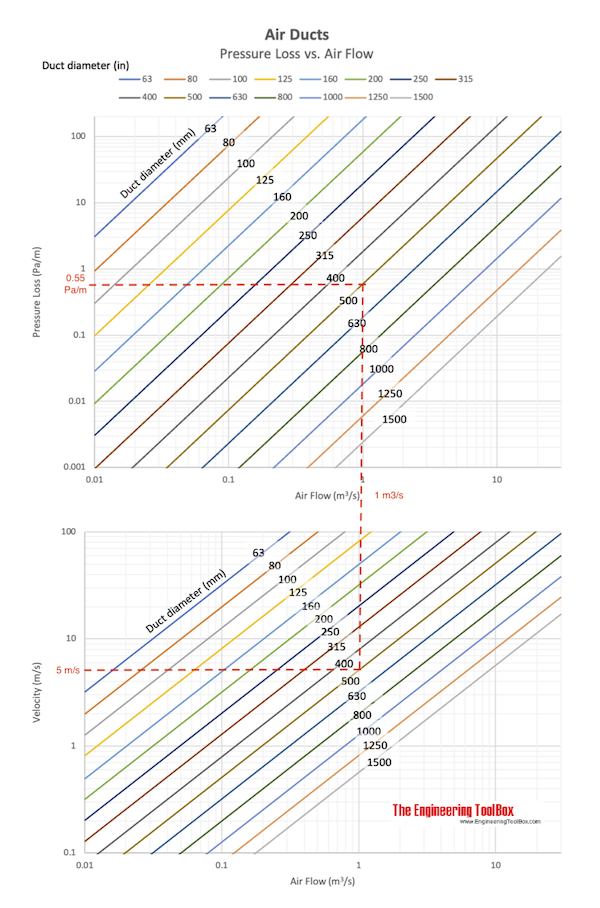
A fan’s rated CFM is measured under ideal conditions with zero static pressure. Real-world performance drops significantly due to resistance.
What Reduces Actual CFM
Several factors reduce airflow in ducted systems:
• Duct length: Every 10–20 feet reduces airflow
• Bends and elbows: Each 90-degree elbow causes up to 25% loss
• Flexible ducting: Creates more friction than rigid metal
• Wall caps, grilles, and filters: Add backpressure
• Grease traps in kitchen hoods: Restrict airflow over time
Increase calculated CFM by 10–25% if duct runs exceed 25 feet, more than two 90-degree elbows are used, long horizontal runs exist, or flexible duct is being used.
For a calculated CFM of 300 with a 20% duct loss adjustment: 300 × 1.2 = 360 CFM. Choose a fan rated at 350–400 CFM.
Prevent Negative Pressure and Backdrafting
High-CFM fans can create negative pressure, pulling air from unintended sources.
Risks of Oversized Fans
Oversized fans can cause backdrafting, where combustion appliances such as furnaces or water heaters suck in fumes instead of exhausting them properly. They also pull out conditioned air and replace it with unconditioned air, causing energy waste. Drafts and discomfort result, and utility bills increase.
Solutions
Install make-up air vents for fans exceeding 400 CFM. Use variable-speed fans or timers to match airflow to actual use. In tight homes, consider energy recovery ventilators (ERVs) to maintain balanced airflow.
Code Tip: Some jurisdictions require make-up air for exhaust fans over 300–400 CFM. Check local codes before installation.
Measure Existing Fan Performance
Do not trust labels alone. Verify airflow with field testing.
Use an Anemometer
Turn the fan on and let it stabilize. Hold an anemometer at the duct outlet or grille. Take multiple readings and average them. Measure duct area using the round duct formula: Area = (π × d²) ÷ 576, where d is diameter in inches.
Calculate CFM by multiplying velocity (FPM) by duct area in square feet.
For example, with 800 FPM velocity through a 10-inch round duct: area = (3.14 × 10²) ÷ 576 = 0.545 sq ft. CFM = 800 × 0.545 = 436 CFM.
This confirms whether the fan delivers its rated airflow.
Compare Fan Types and Sones
CFM is not the only specification that matters.
Fan Types by Application
• Axial fans work best for short duct runs and bathrooms. They handle lower pressure but become noisy at high CFM.
• Centrifugal fans excel at long ducts and kitchens. They handle resistance better than axial types.
• Inline duct fans are ideal for concealed runs and attics. They work well for complex installations.
Check the Sones Rating
Sones measure perceived loudness. A rating at or below 1.0 sone indicates very quiet operation, ideal for bedrooms. Ratings at or below 3.0 sones are acceptable for most homes. Anything above 3.0 sones produces a noticeable hum.
Look for ENERGY STAR certified fans, which must meet standards of 2.8 watts per CFM or less while maintaining quiet operation.
Convert Between CFM and Metric Units
Sometimes you need m³/hr or L/s instead of CFM.
Conversion Formulas
To convert CFM to m³/hr, multiply by 1.699. To convert CFM to L/s, multiply by 0.4719. To convert m³/hr to CFM, multiply by 0.589. To convert L/s to CFM, multiply by 2.1189.
For example, 300 CFM equals 300 × 1.699 = 509.7 m³/hr, or 300 × 0.4719 = 141.6 L/s.
Avoid Common Sizing Mistakes
Even professionals get sizing wrong. Steer clear of these errors.
Do Not Rely on Horsepower or RPM
Horsepower and RPM do not directly correlate to CFM. Two fans with identical horsepower can have vastly different airflow capacities.
Do Not Ignore Duct Design
A 400 CFM fan on a 20-foot flexible duct with three elbows may deliver only 250 CFM in practice.
Do Not Use One Fan for Multiple Rooms
Shared bathrooms or open-concept spaces require combined volume plus usage analysis. One fan rarely suffices.
Do Not Skip Makeup Air
Large kitchen hoods in tightly sealed homes cause pressure imbalances that pull combustion gases back into living spaces.
Best Practice: Always size based on worst-case scenario and real installation conditions, not ideal laboratory measurements.
Final Checklist: Did You Size It Right?
Before purchasing, verify you have completed each step:
• Measured room volume (L × W × H)
• Identified correct ACH for your room type
• Applied ASHRAE 62.2 for bathrooms (1 CFM per sq ft or 50 CFM minimum)
• For kitchens, applied BTU or width rule
• Chose the higher CFM when multiple methods apply
• Added 10–25% buffer for duct losses
• Checked sones rating for noise level
• Verified need for make-up air
• Confirmed with anemometer if possible
Key CFM Formulas at a Glance

Use these formulas for quick reference:
• Room Volume: L × W × H
• Required CFM: (Volume × ACH) ÷ 60
• Gas Stove CFM: (Total BTUs ÷ 10,000) × 100
• Electric Stove CFM: Width in inches × 10
• Bathroom CFM: Maximum of (Area) or 50
• CFM from FPM: Velocity × Duct Area
• Duct Area (Round): πd² ÷ 576
• ACH from CFM: (60 × CFM) ÷ Volume
When to Call a Professional
DIY methods work well for standard bathrooms and kitchens. However, seek professional help for commercial kitchens requiring UL-listed hoods and fire suppression systems. Server rooms with heat load calculations need expert sizing. Complex duct systems over 50 feet require professional design. Tight homes needing balanced ventilation benefit from ERV or HRV installation. Industrial exhaust systems for fumes, chemicals, or high ACH applications demand licensed HVAC technicians.
A professional can perform blower door tests, static pressure checks, and system balancing for optimal performance.
Frequently Asked Questions About Calculating Exhaust Fan CFM
What is the simplest way to calculate CFM for a bathroom?
Measure your bathroom floor area in square feet. For bathrooms with showers or tubs, use 1 CFM per square foot or 50 CFM minimum, whichever is higher. This follows ASHRAE 62.2 standards and ensures adequate moisture removal.
How do I calculate CFM for a kitchen range hood?
Calculate cubic feet (length × width × height), multiply by 15–25 ACH, then divide by 60. Alternatively, for gas stoves, use 100 CFM per 10,000 BTUs. For electric stoves, use width in inches multiplied by 10. Choose the higher result.
Does duct length affect exhaust fan CFM performance?
Yes. Duct resistance significantly reduces actual CFM. Add 10–25% to your calculated CFM if duct runs exceed 25 feet, use multiple elbows, or install flexible ducting instead of rigid metal.
Can an exhaust fan be too powerful?
Yes. Excessively high CFM creates negative pressure, which can back-draft combustion appliances and waste energy by exhausting conditioned air. It can also cause drafts and discomfort. Match CFM precisely to room requirements.
How do I measure my existing fan’s actual CFM?
Use an anemometer to measure air velocity in feet per minute at the duct outlet. Multiply by the duct cross-sectional area in square feet. This gives you the actual CFM your fan delivers under real conditions.
Key Takeaways for Calculating Exhaust Fan CFM
Getting the right CFM is essential for health, comfort, and efficiency in any ventilated space. Start by calculating room volume (length × width × height), then apply the appropriate air changes per hour for your room type. Use the formula CFM = (Volume × ACH) ÷ 60 as your foundation. For bathrooms, apply the ASHRAE 62.2 rule of 1 CFM per square foot or 50 CFM minimum. For kitchens, compare volume-based calculations against BTU or width rules and always choose the higher value. Add a 10–25% buffer for duct losses, check sones ratings for quiet operation, and verify performance with an anemometer after installation. Whether you need a 50 CFM bathroom fan or a 500 CFM range hood, accurate sizing prevents problems before they start.
Leave a Reply